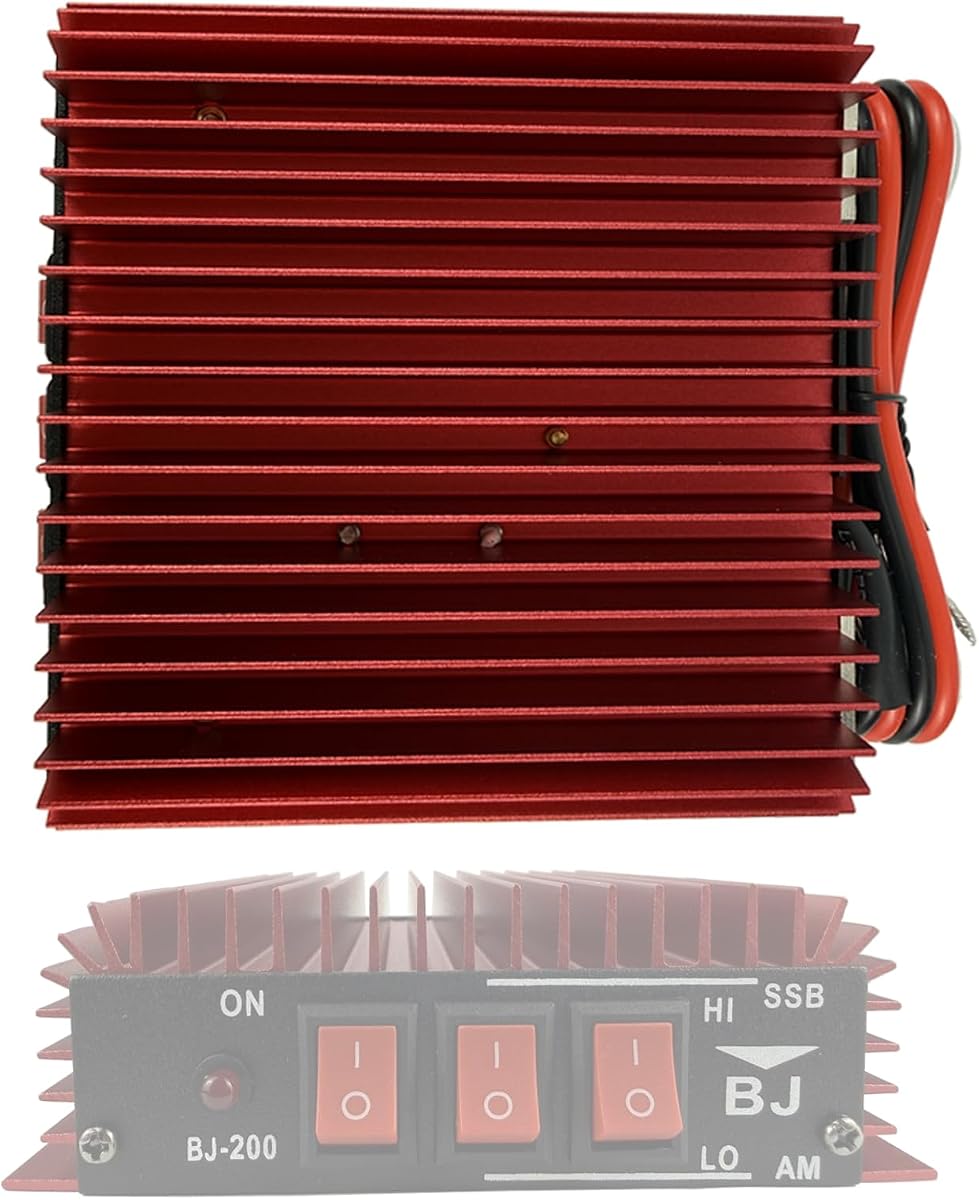
BJ-200 Linear Power AMP, 3-30MHz Radio AMP 50W FM 100W AM 150W SSB for 3-5W Input 2-Way Radio Transceiver, 13.8V
5.0Editor score
150W SSB output
Compact design
Polarity protection
This guide compares the top linear amplifiers for ham radio to help you choose the right RF power booster for your HF station and QRP setup.
Linear amplifiers are essential for hams seeking to extend their communication range and improve signal clarity. A good unit boosts low-power transceiver output into reliable high-power transmission while maintaining signal purity.
We analyzed ten top-rated models based on power output, band coverage, protection features, and user feedback. This list covers everything from compact QRP boosters to full-featured HF amplifiers with built-in tuners.
Each pick highlights key specs, strengths, and trade-offs to help you find the best fit for your budget and station needs. Remember that availability and pricing can change, so verify details before purchasing.
5.0Editor score

4.2Editor score

3.9Editor score
The following table provides a side-by-side comparison of all ten models featured in this guide. Use it to quickly compare output power, band support, protection features, and key strengths across the lineup.


The Xiegu GPA100 is a solid-state linear amplifier that delivers clean 100W RF output across HF bands. It earns top marks for its intelligent auto band switching and Bluetooth integration for select transceivers.
We may earn a commission when you buy through this link, at no additional cost to you.
Its standout features include manual or auto band selection with clear indicator lights, plus intelligent protection against SWR, overcurrent, and overheating. The Bluetooth link works seamlessly with the IC-705, eliminating extra cables during operation.
Operators may find the seven-band manual selection limiting for those who operate across many HF segments. However, the auto mode and built-in protections make up for it, ensuring safe extended use even when switching bands frequently.
This unit is best suited for QRP enthusiasts who want reliable 100W output without manual band adjustments. It pairs perfectly with popular Xiegu and IC-705 transceivers, making it a smart choice for modern portable and base stations.
The built-in band control allows seamless transitions between modes without manual intervention, keeping operators focused on communication.
Advanced protection circuits detect high SWR or overheating and adjust performance to prevent damage to both the amp and connected radio.
We may earn a commission when you buy through this link, at no additional cost to you.
The BJ-300 Plus delivers up to 150W SSB output, making it a cost-effective option for users who need substantial power boost. It supports AM, FM, SSB, and CW modes, fitting well with CB and Ham radio setups.
We may earn a commission when you buy through this link, at no additional cost to you.
It includes a high-efficiency cooling fan and aluminum heat sink to maintain stability during extended use. Electronic polarity reversal protection and dual fuses protect against common power connection mistakes and electrical surges.
User controls are minimal, featuring a power switch and HI/LO adjustment without detailed digital displays. This simplicity can be helpful for quick setups but lacks fine-tuning options available in premium amplifiers.
Ideal for beginners or budget-conscious operators needing a no-frills power boost, this model offers excellent value. Its straightforward design and protective features make it a reliable companion for daily HF and CB communications.
With outputs reaching 150W on SSB, this amplifier extends range significantly for both voice and digital transmission modes.
The integrated cooling fan and heat sink help prevent overheating, ensuring consistent performance even during long operating sessions.
We may earn a commission when you buy through this link, at no additional cost to you.
The Xiegu XPA125B combines a 100W amplifier with an automatic antenna tuner, offering dual functionality in one compact unit. Its integrated tuner handles various loads across HF and the 6-meter band.
We may earn a commission when you buy through this link, at no additional cost to you.
A 2.7-inch backlit LCD displays real-time data like power, SWR, temperature, and voltage. When abnormal conditions occur, the system enters bypass mode and shows warning messages to protect both the amplifier and radio.
Though it delivers solid performance, user feedback reflects mixed experiences with tuning consistency and reliability. Its modern size reduction from older versions is a notable improvement for portable and base stations.
Operators seeking an all-in-one solution with an integrated tuner will find this model compelling. Its blend of power, protection, and display clarity makes it a strong premium choice for versatile HF operations.
The tuner and amp can operate independently, giving users flexibility to use just the tuner for low-power or just the amp for matched loads.
A large LCD screen provides essential operating data at a glance, simplifying setup and reducing guesswork during transmission.
We may earn a commission when you buy through this link, at no additional cost to you.
This variant of the BJ-300 Plus delivers similar high-power performance with up to 150W on SSB, catering to HF and CB enthusiasts. It supports AM, FM, SSB, and CW, extending communication range effectively.
We may earn a commission when you buy through this link, at no additional cost to you.
A high-efficiency cooling fan and large heat sink ensure stable operation even during extended transmission. Polarity reversal protection and dual fuses protect against power surges and incorrect wiring, which is critical in mobile or temporary setups.
Controls are straightforward with power switch and HI/LO adjustment. The absence of advanced digital indicators limits fine-tuning but keeps the unit simple and reliable for users prioritizing power over features.
For operators seeking reliable range extension without complex interfaces, this amplifier is a practical pick. Its protection features and cooling design help it endure regular use in varied environments.
High power output significantly extends communication reach for both voice and digital modes, especially in weak signal conditions.
Built-in polarity protection and robust cooling help prevent common failures, ensuring consistent performance over time.
We may earn a commission when you buy through this link, at no additional cost to you.
The BJ-300 provides up to 150W output for SSB, AM, and FM, offering versatile performance for HF transceivers. It accepts low input power and delivers consistent amplification across standard amateur modes.
We may earn a commission when you buy through this link, at no additional cost to you.
Its built-in overvoltage protection safeguards against power fluctuations, while the HI/LO power switch allows adapting output to different transmission needs. A compact aluminum alloy heat sink ensures efficient heat dissipation.
The lack of user ratings makes long-term reliability less clear, but the design prioritizes durability and safety. Basic LED indicators and PL-259 connectors simplify setup for operators of all experience levels.
For those needing a straightforward, protected amplifier without advanced controls, this model delivers solid value. It is particularly useful in CB, Ham, and general HF radio applications where range matters.
HI/LO power selection lets users adjust signal strength based on band conditions or regulatory limits without manual circuit changes.
Overvoltage protection and aluminum construction help prevent damage from power issues, ensuring safer daily operation.
We may earn a commission when you buy through this link, at no additional cost to you.
The BJ-200 offers impressive output levels with 150W on SSB, 100W on AM, and 50W on FM, all from a compact chassis. It covers the full HF range and supports AM, FM, and SSB modes.
We may earn a commission when you buy through this link, at no additional cost to you.
Users rate it highly for its reliable performance and robust build quality. The red aluminum heat sink and clear ON/OFF switch, HI/LO, and AM/SSB selectors make it easy to operate in the field or base.
While it lacks advanced monitoring or auto band tracking, its simplicity is a strength for straightforward operation. The included polarity reversal protection safeguards the amp from common power connection mistakes.
Ideal for mobile or portable setups where space is limited, this amplifier delivers maximum power in a small package. Its strong rating and simple design make it a reliable choice for regular HF and CB use.
Its rugged yet small form factor allows easy installation in vehicles or tight base station spaces without sacrificing output capability.
Perfect five-star feedback reflects strong user satisfaction with its stability and power delivery in real-world conditions.
We may earn a commission when you buy through this link, at no additional cost to you.
This Xiegu model combines a 100W amplifier with a built-in automatic antenna tuner, offering dual functionality for flexible operation. The tuner handles loads from 14 to 500 ohms across HF and 6 meters.
We may earn a commission when you buy through this link, at no additional cost to you.
Its large 2.7-inch LCD provides clear readings of power, SWR, voltage, current, and temperature. Intelligent protection circuits detect SWR, drive power, and temperature anomalies, switching to bypass mode to prevent hardware damage.
The refined and smaller design improves portability, but users note occasional tuning inconsistencies that require patience. The visual interface and alarms help simplify daily adjustments for experienced operators.
Operators who value integrated tuners and real-time monitoring will find this unit useful despite mixed reviews. Its protective features and dual capability make it a worthwhile investment for comprehensive HF stations.
The unit can operate as a standalone tuner or amplifier, providing flexible options for different operating scenarios.
A large backlit screen displays critical data, helping users monitor performance and spot issues quickly.
We may earn a commission when you buy through this link, at no additional cost to you.
This board delivers 30W of clean linear output across the entire shortwave spectrum, ideal for CW and SSB modes. It uses advanced broadband circuitry to maintain consistent gain without manual tuning.
We may earn a commission when you buy through this link, at no additional cost to you.
Designed for integration with QRP transceivers and kits, it includes clearly marked input/output ports and power connections. The PCB features low-loss material and a heat sink for stable operation during long transmit cycles.
Technical users can appreciate its robust thermal management and protection against current and voltage fluctuations. Since it is a board, some assembly or enclosure adaptation may be necessary compared to ready-made units.
For hobbyists building custom rigs or upgrading QRP setups, this module provides reliable performance and flexibility. Its efficiency and full band support make it a versatile option for serious DXers and contest operators.
The circuitry delivers consistent gain across 3 to 30MHz without tuning, ensuring stable amplification across all HF bands.
A low-loss PCB and integrated heat sink prevent overheating during extended use, protecting both the board and connected equipment.
We may earn a commission when you buy through this link, at no additional cost to you.
This CB-focused amplifier accepts 12-14V DC input and uses a simple three-wire connection for quick setup. It fits standard automotive or stationary CB power supplies, making it easy to integrate into vehicles.
We may earn a commission when you buy through this link, at no additional cost to you.
SO-239 connectors handle RF input and output, aligning with common CB and Ham setups. The unit maintains stable performance during engine starts, which is crucial for mobile operations where power fluctuations occur.
It lacks detailed controls or mode selectors, prioritizing simplicity for straightforward applications. For users focused on CB or low-power HF boosting, its design is functional but limited for broader amateur needs.
Best suited for CB users needing a reliable, easy-to-install power boost, this model delivers value through simplicity. Its stability during power changes makes it suitable for mobile use.
With a three-wire setup and standard connectors, this amplifier simplifies installation in vehicles and temporary stations.
The design ensures stable operation during engine start and voltage shifts, reducing interruptions in mobile communications.
We may earn a commission when you buy through this link, at no additional cost to you.
This LNA offers 32dB gain and low noise across 0.1 to 2000MHz, improving reception for CB, shortwave, FM, and Ham. It works well as a preamp for SDR and receivers in weak signal conditions.
We may earn a commission when you buy through this link, at no additional cost to you.
It consumes just 27mA and runs on 9-12V DC, making it portable and battery-friendly. Its consistent 50 ohm impedance ensures compatibility with most HF and VHF setups without additional matching.
While excellent for receiving, it is not designed for transmit power amplification. Its narrow output and focus on front-end improvement suit listeners and SDR users needing enhanced sensitivity.
For operators aiming to improve weak signal reception across bands, this preamp provides significant clarity. Its low noise figure and wide coverage make it a valuable addition for SDR, shortwave listening, and Ham stations.
Its 32dB gain and low noise figure significantly boost incoming signals, making distant stations easier to copy.
Compatible with common battery and 12V supplies, it supports both fixed and portable receiver setups with ease.
We may earn a commission when you buy through this link, at no additional cost to you.
Selecting the right linear amplifier involves balancing output power, protection features, and compatibility with your transceiver and antenna setup.
Consider the maximum wattage your station needs for HF, SSB, AM, or FM transmission. Most QRP users benefit from 100W, while high-power operations may need more. Check band-specific output ratings to ensure adequate performance.
Prioritize models that deliver consistent output across your primary modes without overloading your transceiver.
Determine if you need automatic band switching, manual selection, or integrated antenna tuning. Units with auto band switching reduce operator workload during rapid changes, while tuners simplify matching various antennas.
Choose amplifiers that support your operating bands to avoid gaps in performance during HF communication.
Look for built-in protection against high SWR, overcurrent, overheating, and voltage fluctuations. These safeguards extend the lifespan of both the amplifier and your transceiver during long or emergency sessions.
Amps with visible indicators or alarm messages make it easier to spot and resolve issues quickly.
Ensure the amplifier accepts your transceiver's input power and uses compatible connectors like PL-259 or SO-239. Some models support automatic control for specific transceivers, streamlining operation.
Check for Bluetooth or wired control options if you prefer simplified band tracking during operations.
Efficient heat dissipation is critical for sustained transmission. Models with fans and large heat sinks prevent overheating during extended QSOs or contests, maintaining stable output.
Prioritize designs that balance cooling efficiency with noise levels and power consumption.
User-friendly interfaces with clear displays and simple switches reduce setup time. Models with digital displays offer valuable feedback, while basic switches suit those who prefer straightforward operation.
Consider control complexity based on your experience level and operating frequency.
Compact and rugged builds are essential for mobile and field deployments. Check weight and dimensions to ensure the amplifier fits in your vehicle or portable station.
Quality construction with aluminum housings and secure ports improves durability in varied environments.
Compare features against overall cost and available support or warranty. Higher-priced models often include advanced protections or integrated tuners that reduce additional purchases.
Balance initial investment with long-term reliability and performance needs.
Connect the amplifier between your transceiver and antenna using proper RF cables and connectors. Ensure power connections match the specified voltage to avoid damaging the unit. Verify polarity before powering on to prevent reverse current issues.
Allow the amplifier to warm up before transmission to ensure stable performance. Monitor heat and fan operation during long sessions to prevent overheating. Adjust output power using HI/LO switches or controls as needed for band conditions.
Store the unit in a dry, ventilated location when not in use to protect internal components. Regularly inspect connectors and cables for wear. Keep firmware and control software updated if the model supports digital features.
Linear amplifiers boost signal power while preserving waveform integrity, ensuring minimal distortion on SSB and CW modes. Unlike nonlinear boosters that may introduce harmonic interference, linear amps maintain clean transmission for amateur radio compliance.
Not always. Models with built-in tuners handle impedance matching automatically. If your amplifier lacks a tuner, use an external unit to optimize antenna performance and protect the amplifier from high SWR conditions.
Yes. Many amplifiers accept 3-5W input and boost it to 100W output. Verify the input power range in the amplifier's specs to ensure compatibility with your QRP or low-power transceiver without damage.
Bluetooth control allows automatic band switching and settings synchronization with supported transceivers. This reduces manual intervention and simplifies operation, especially for operators changing bands frequently during contests or DX sessions.
Amplifiers with SWR protection reduce output or enter bypass mode to prevent damage. Some display alarms or adjust automatically. Always resolve antenna mismatches promptly to maintain safe operation and prolong amplifier life.
Fans dissipate heat generated during transmission, maintaining stable output during long sessions. Active cooling extends component lifespan and prevents thermal shutdowns, making it essential for high-power or continuous operation.
Yes. Many models support HF bands and the 6-meter range, with some covering 3-30MHz. Check the product's band coverage list to ensure it aligns with your operating plan and transceiver capabilities.
Choose models with built-in polarity reversal and overvoltage protection. Add external surge protectors or line conditioners for mobile and base stations. Proper grounding and fuses also safeguard against electrical issues.
This guide highlights the top ten linear amplifiers for ham radio, balancing power output, protection, and features for diverse operator needs. The Xiegu GPA100 leads with auto band switching and Bluetooth control, while the BJ-200 delivers excellent value for budget users.
Prioritize amplifiers with built-in protection, efficient cooling, and compatibility with your transceiver and bands. Operators needing an integrated tuner should consider the XPA125B, whereas QRP enthusiasts may prefer compact models like the LICAEVEY board.
Verify current availability, features, and compatibility before purchase as offerings change frequently. Choose the model that best fits your operating style, whether mobile, portable, or fixed station, for reliable and clear communication.