
EBOOT 30 Pieces Photoresistor
4.6Editor score
30 count package
5mm GM5539 resistor
Low cost per unit
This guide compares the top light sensors for Arduino to help you choose the right module for your next electronics or automation project easily.
Light sensors are essential components for any Arduino project that requires environmental awareness or automated control based on illumination levels. Whether you are building a smart home system or a simple light following robot, selecting the right sensor is crucial for reliability and accuracy in your final build.
We have evaluated the top ten light sensors available for Arduino enthusiasts and professionals. Our comparison focuses on output, ease of integration, and specific features like analog versus digital output to help you make an informed decision for your unique project requirements and budget constraints.
Each product in this list offers unique capabilities ranging from basic photoresistors to advanced digital modules. Please note that prices and availability change frequently on Amazon, so we recommend checking the current listings before making your final purchase to ensure you get the best value today.
4.6Editor score

4.4Editor score
4.7Editor score
The following table provides a side-by-side comparison of all ten products evaluated in this guide. It highlights key specifications and ratings to help you quickly identify the best match for your specific project needs.



This module combines a 5mm LDR with an LM393 comparator to offer reliable ambient light detection. It is a top choice for hobbyists who need a stable digital or analog signal for threshold-based control projects.
We may earn a commission when you buy through this link, at no additional cost to you.
The comparator output provides a clean waveform with strong driving capability exceeding 15mA. This ensures your microcontroller receives a stable signal even in noisy environments, making it suitable for triggering relays directly.
One trade-off is the fixed 3.3 to 5V supply requirement. However, this range covers most standard microcontrollers, so it remains versatile for general Arduino usage without extra voltage regulators.
We recommend this module for users who want a simple yet robust light detection solution. It strikes an excellent balance between cost and performance for everyday automation tasks.
The integrated comparator ensures that the digital output is clean and free from noise, which is vital for reliable switching in automated systems.
A built-in potentiometer allows you to tune the detection brightness manually, giving you flexibility across different environmental conditions without code changes.
We may earn a commission when you buy through this link, at no additional cost to you.
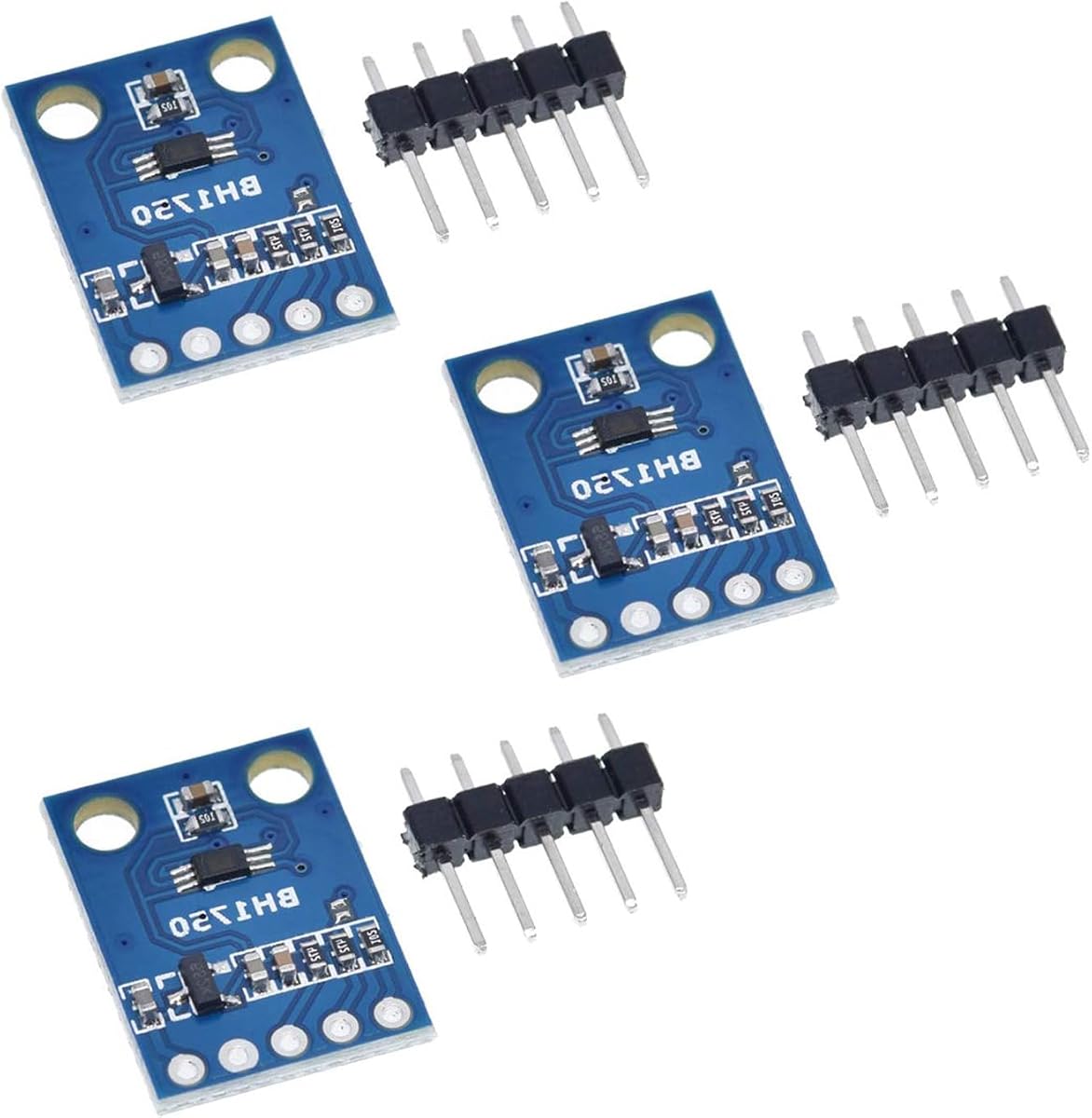
This module uses the BH1750FVI chip to deliver precise light intensity measurements directly in digital format. It is an ideal choice for projects requiring exact lux readings rather than simple threshold switching.
We may earn a commission when you buy through this link, at no additional cost to you.
The high-quality chip from ROHM ensures accurate readings across a wide range of light conditions. This makes it superior for tasks like automatic screen dimming or sophisticated environmental monitoring where precision is paramount.
The small size is a key advantage for tight spaces, but you must use I2C communication which requires two extra pins. For simple threshold detection, a basic LDR might be easier to wire for beginners.
We recommend this module for advanced users who need accurate data and digital output. Its performance justifies the slightly higher cost for professional or precise electronic projects.
The BH1750FVI chip provides high-quality light intensity data that is reliable for complex monitoring systems and precise control loops in your application.
With dimensions of 13.9mm x 18.5mm, this module fits easily into compact designs, allowing for clean and organized breadboard or soldered circuit layouts.
We may earn a commission when you buy through this link, at no additional cost to you.
This module offers a similar performance profile to other BH1750 units but ensures authenticity with the original ROHM chip. It provides precise light intensity measurements through a digital interface for accurate readings.
We may earn a commission when you buy through this link, at no additional cost to you.
The consistent performance of the chip makes it suitable for projects where reliability is key. Having three units in the pack allows you to experiment or backup your main sensor without additional purchases.
The main limitation is the I2C requirement which is slightly more complex than analog wiring. However, for digital precision, this is a standard requirement that most Arduino users can manage easily.
We recommend this module for those seeking authentic digital light sensing components. It offers a robust solution for precise environmental monitoring at a competitive price point.
Using the original ROHM chip ensures you get the expected accuracy and reliability from the BH1750FVI sensor, avoiding issues with counterfeit parts.
The wide power supply range of 3 to 5 volts allows this module to work with a variety of microcontrollers including 3.3V logic boards.
We may earn a commission when you buy through this link, at no additional cost to you.
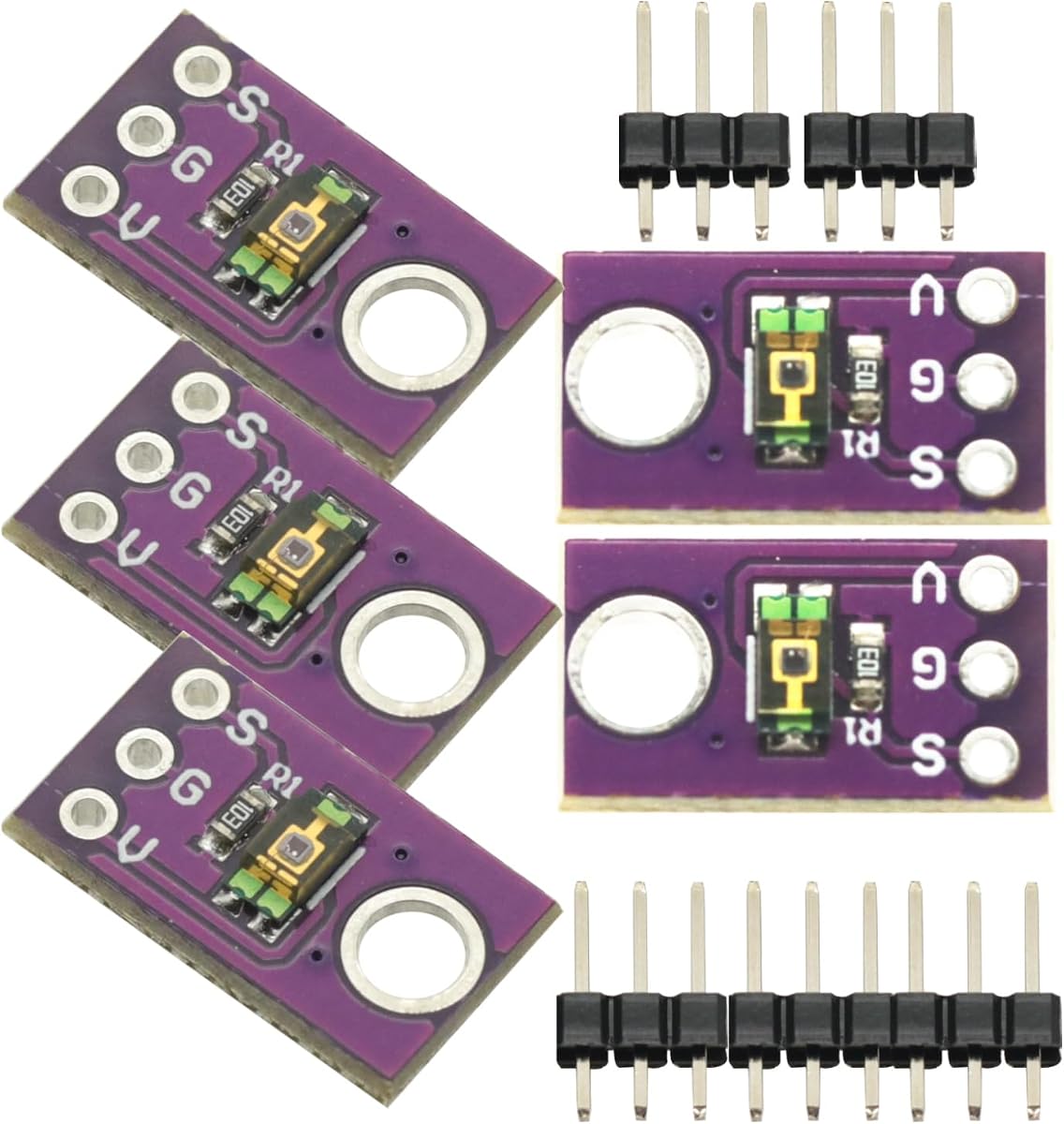
This module is designed to sense light primarily from the direction directly in front of it. This directionality makes it ideal for projects that need to detect specific light sources rather than general ambient light.
We may earn a commission when you buy through this link, at no additional cost to you.
The ability to detect brightness and intensity with high directionality improves light seeking effects significantly. This feature allows your project to respond more accurately to targeted light sources in the environment.
The adjustable sensitivity via the blue potentiometer is a strong feature for customization. However, relying on directional sensing means you must mount it correctly to avoid false readings from side light.
We recommend this module for robots or devices that need to track specific light signals. Its directional capabilities offer a distinct advantage over standard omnidirectional sensors.
The photodiode only senses light directly in front of the sensor, allowing for better light seeking effects and reduced interference from side ambient light.
You can tune the sensitivity using a blue digital potentiometer on the board, which helps adapt the sensor to different lighting conditions effectively.
We may earn a commission when you buy through this link, at no additional cost to you.
This pack of thirty 5mm photoresistors offers incredible value for anyone building multiple projects. Each resistor provides the standard light dependent resistance needed for simple ambient detection circuits.
We may earn a commission when you buy through this link, at no additional cost to you.
The maximum voltage of 150V and spectral peak of 540nm make these versatile for various lighting conditions. They are reliable components that perform well in standard Arduino circuits without extra complexity.
The only trade-off is the need for external components to create a voltage divider. However, if you have basic resistors on hand, this bulk pack saves money compared to buying pre-made modules.
We recommend this option for students or makers who need components for class projects or experiments. It provides the best cost per unit for raw sensing elements.
With a maximum voltage rating of 150V DC, these resistors are robust enough to handle unexpected spikes in voltage without immediate failure.
Having 30 light sensitive resistors allows you to build multiple prototypes or circuits for classroom settings without needing repeated purchases.
We may earn a commission when you buy through this link, at no additional cost to you.
This pack offers ten ready-to-use modules with an LM393 comparator for simplified digital light detection. It is perfect for projects requiring multiple sensors or a reliable trigger mechanism without extra circuitry.
We may earn a commission when you buy through this link, at no additional cost to you.
The module triggers when ambient light intensity crosses a set threshold, providing a clear high or low level output. This makes it easy to integrate into simple automation systems like automatic night lights.
While it offers convenience, you still need to adjust the potentiometer for your specific environment. The fixed logic is acceptable for basic switching but lacks the nuance of analog voltage monitoring.
We recommend this module for users who want simplicity and reliability for bulk builds. It reduces wiring time and ensures consistent performance across multiple units.
The module is most sensitive to ambient light, making it commonly used to detect the brightness of the environment around the sensor effectively.
You can drive a relay module directly from the output to form a light-operated switch, enabling automated control of external devices.
We may earn a commission when you buy through this link, at no additional cost to you.
This module is explicitly designed to work with ESP32 and ESP8266 boards, making it a great choice for IoT projects. It provides both digital and analog outputs for flexible integration into your code.
We may earn a commission when you buy through this link, at no additional cost to you.
The built-in potentiometer allows you to set the trigger threshold easily, enabling reliable on-off control based on light levels. This feature is particularly useful for smart home automation tasks.
Tutorials are provided which helps beginners get started quickly without extensive documentation searches. However, the module requires code setup to interpret the signals correctly on your board.
We recommend this module for IoT enthusiasts using ESP boards. Its compatibility and included resources streamline the development process for connected devices.
This module works with ESP32 and ESP8266 microcontrollers, ensuring you can use it for modern IoT projects without voltage issues.
You get both digital and analog outputs, giving you the flexibility to choose between threshold detection or precise analog reading.
We may earn a commission when you buy through this link, at no additional cost to you.
This is an excellent bulk pack of 50 GL5516 photoresistors. It provides a massive amount of components for anyone building multiple light sensors for larger installations or classroom use.
We may earn a commission when you buy through this link, at no additional cost to you.
The GL5516 resistors have a high dark resistance of 0.2MOhm and low bright resistance of 5-10K Ohm. This contrast ensures clear signal differentiation between light and dark states for accurate detection.
Since these are raw components, you must build the voltage divider circuit yourself. While this requires more work, it allows for custom circuit design tailored to specific project constraints.
We recommend this option for advanced users and educators needing volume. It offers the best value for raw photoresistors for scaling up multiple projects.
With resistance ranging from 5-10K Ohm in bright light to 0.2MOhm in darkness, these sensors provide a wide range for clear signal detection.
These resistors are particularly suitable for light automation and solar tracking projects where detecting light direction and intensity is crucial.
We may earn a commission when you buy through this link, at no additional cost to you.
This module is designed for professional ambient light sensing with a perfect user rating. It excels in applications like display backlight dimming and industrial lighting control due to its specialized design.
We may earn a commission when you buy through this link, at no additional cost to you.
The high rating reflects its reliability in critical applications where consistent performance is required. It provides stable readings suitable for industrial lighting control where errors are costly.
While it is excellent for specific use cases like backlight dimming, it may be overkill for simple hobby projects. However, if you need precision, this module delivers top tier performance.
We recommend this module for professional applications and industrial tasks. Its specialized features ensure high reliability in controlled environments.
This sensor is optimized for controlling display backlight dimming in LCD displays, ensuring optimal visibility and power efficiency.
The professional grade design ensures high reliability in industrial environments, making it suitable for critical control operations.
We may earn a commission when you buy through this link, at no additional cost to you.
This module uses the LM393 comparator to provide stable digital and analog outputs suitable for smart car applications. It is designed to handle the voltage fluctuations often found in vehicle environments.
We may earn a commission when you buy through this link, at no additional cost to you.
The stability of the output is crucial for automotive projects where reliable detection is necessary. The module ensures that light intensity detection remains consistent despite power variations.
It is ideal for smart car projects requiring light detection for automatic lights or sensors. However, the three pack limit may be restrictive if you need multiple sensors for a complex setup.
We recommend this module for automotive electronics and smart car projects. Its stability and output options make it a reliable choice for vehicle integration.
The wide voltage LM393 comparator ensures good stability, which is essential for reliable light intensity detection in variable environments.
Widely used in smart car applications, this module is well suited for vehicle lighting and sensor systems requiring robust detection.
We may earn a commission when you buy through this link, at no additional cost to you.
Selecting the right light sensor depends on your project requirements such as precision, output type, and environmental conditions. This guide outlines key factors to consider.
There are two main types of sensors: Photoresistors (LDR) and Photodiodes. Photoresistors are simple and inexpensive, ideal for hobbyist projects requiring basic light detection. Photodiodes offer faster response times and better linearity, suitable for more technical applications.
Choose a photoresistor for simple cost effective projects and a photodiode for advanced technical needs.
Modules may offer analog (AO) or digital (DO) outputs. Analog outputs provide a continuous voltage reading corresponding to light intensity which allows for precise control. Digital outputs provide a simple binary high or low signal based on a set threshold.
Select analog for precise measurements and digital for simple on off switching logic.
Ensure the module operates within the voltage range of your microcontroller. Most modules operate at 3.3V or 5V. Using a module that does not match your board's voltage can damage components or cause unreliable readings.
Verify the supply voltage range matches your Arduino or ESP board to prevent damage.
Adjustable sensitivity via a potentiometer allows you to fine tune the sensor for different environments. This is particularly useful for projects where lighting conditions vary widely or need custom calibration.
Look for a built-in potentiometer to easily adjust sensitivity without changing code.
Response speed is the time it takes for the sensor to react to changes in light. Photoresistors are relatively slow while photodiodes react almost instantly. This matters for applications like robotics or high speed light pulses.
Choose a faster photodiode if your project requires quick light signal processing.
Some sensors are omnidirectional while others are directional. Directional sensors only sense light from a specific angle which is useful for avoiding interference from side ambient light in complex setups.
Use directional sensors to focus on specific light sources and avoid background noise.
Consider how many units you need. Buying in bulk often saves money and ensures you have spare parts. If you are building multiple units for a large project bulk packs are more economical than single modules.
Purchase bulk packs for large projects to save money and ensure availability of spares.
Higher quality chips like the BH1750FVI provide more accurate digital readings. For precise tasks like dimming screens or measuring lux, a module with a high quality chip ensures reliability over time.
Opt for modules with known quality chips for precise and reliable digital readings.
To connect a standard analog module, link VCC to 5V or 3.3V, GND to ground, and AO to an analog pin. For digital modules, connect DO to a digital pin to read the threshold state.
Protect your sensor from extreme temperatures and direct water exposure. While many modules are robust, harsh conditions can degrade the photoresistor or photodiode sensitivity over time.
For best results, calibrate your sensor by adjusting the potentiometer while in your target environment. This ensures the readings align with your actual lighting conditions for reliable automation.
An LDR changes resistance based on light levels and is simple and cheap. A photodiode generates current when exposed to light and offers faster response times and better linearity for technical applications.
Connect the analog output pin to an analog input pin on your Arduino. Use the analogRead function to get a value between 0 and 1023 which corresponds to the light intensity level.
If you use a bare LDR you need a resistor to create a voltage divider. Most modules include internal circuitry so you can connect VCC GND and AO directly without extra resistors.
Yes many of these sensors support 3.3V operation which is compatible with ESP32 logic levels. Always check the supply voltage range before connecting to 3.3V boards.
Instability can be caused by power supply noise or environmental light changes. Use a stable power source and shield the sensor from sudden light fluctuations to improve stability.
Use the built-in potentiometer on the module to adjust the trigger level. Turn the knob while monitoring the digital output in the serial monitor until it triggers correctly at your desired brightness.
We have compared ten top rated light sensors ranging from basic bulk packs to precise digital modules. Each offers unique benefits depending on whether you need raw components or ready to use modules for your project.
Prioritize modules with stable outputs and adjustable sensitivity for the best experience. For precision tasks, digital modules with high quality chips provide the reliability you need for professional applications.
Remember that prices and availability change frequently on Amazon. Always check current listings before purchasing to ensure you get the best value for your specific project requirements today.