
LAFVIN R3 Camera Smart Robot Car
4.5Editor score
Cost-effective FPV integration
Open-source learning platform
Five intelligent operation modes
This guide compares the top 10 Arduino Robot Kits for 2026, evaluating features, ease of assembly, programming options, and educational value for makers of all
Arduino robot kits offer an engaging way to learn electronics, coding, and mechanical design through hands-on projects. These kits provide the necessary components and instructions to build functional robots that can move, sense their environment, and interact with users. Whether you are a beginner looking for your first project or an experienced maker seeking advanced capabilities, there is a kit designed to meet your needs and expand your skills.
To compile this list, we evaluated each kit based on assembly complexity, sensor variety, programming flexibility, and overall educational value. We considered user feedback, community support, and the ability to expand projects over time. Our goal was to identify kits that not only work well out of the box but also encourage experimentation and long-term learning in robotics and engineering.
Each pick in this guide highlights specific strengths, such as camera integration, tank tracks, or self-balancing mechanics. We explain what makes each kit unique and who it suits best. Please note that product availability and prices can change frequently, so always check the current listing before purchasing to ensure you get the latest version and best deal.
4.5Editor score

4.5Editor score

4.3Editor score
The following table provides a side-by-side comparison of all ten selected kits, highlighting their core specifications and key capabilities to help you decide which platform fits your project goals and skill level best.


The ELEGOO UNO R3 Smart Robot Car Kit V4 stands out as the top choice for those seeking a balanced mix of ease of use and advanced features. With a strong rating and comprehensive components, it offers a complete experience from assembly to coding. The inclusion of a camera and Wi-Fi module distinguishes it from standard kits by adding real-time visual feedback.
We may earn a commission when you buy through this link, at no additional cost to you.
Its standout quality is the ability to stream live video directly to a phone, enabling FPV driving experiences. The design reduces wiring errors with keyed connectors, making the build process smoother for beginners. The included sensors cover line tracking and obstacle avoidance, providing a solid foundation for learning robotics logic and control systems.
Some users may find the initial app setup slightly inconsistent across different mobile devices. Additionally, first-time builders should plan for adult supervision to ensure safe battery handling and motor alignment. These trade-offs are acceptable given the educational value and the robust features that allow for creative coding extensions beyond basic driving.
This kit is ideal for students, parents, and hobbyists who want a reliable entry point into robotics without sacrificing modern features. We recommend it for weekend projects or classroom STEM activities where visual feedback enhances engagement. It effectively bridges the gap between simple toy robots and programmable engineering platforms.
The FPV camera capability allows learners to see the robot's perspective, which improves spatial awareness and navigation programming skills.
You can start with block-based coding and gradually transition to the Arduino IDE, ensuring the kit grows with your technical skills.
We may earn a commission when you buy through this link, at no additional cost to you.
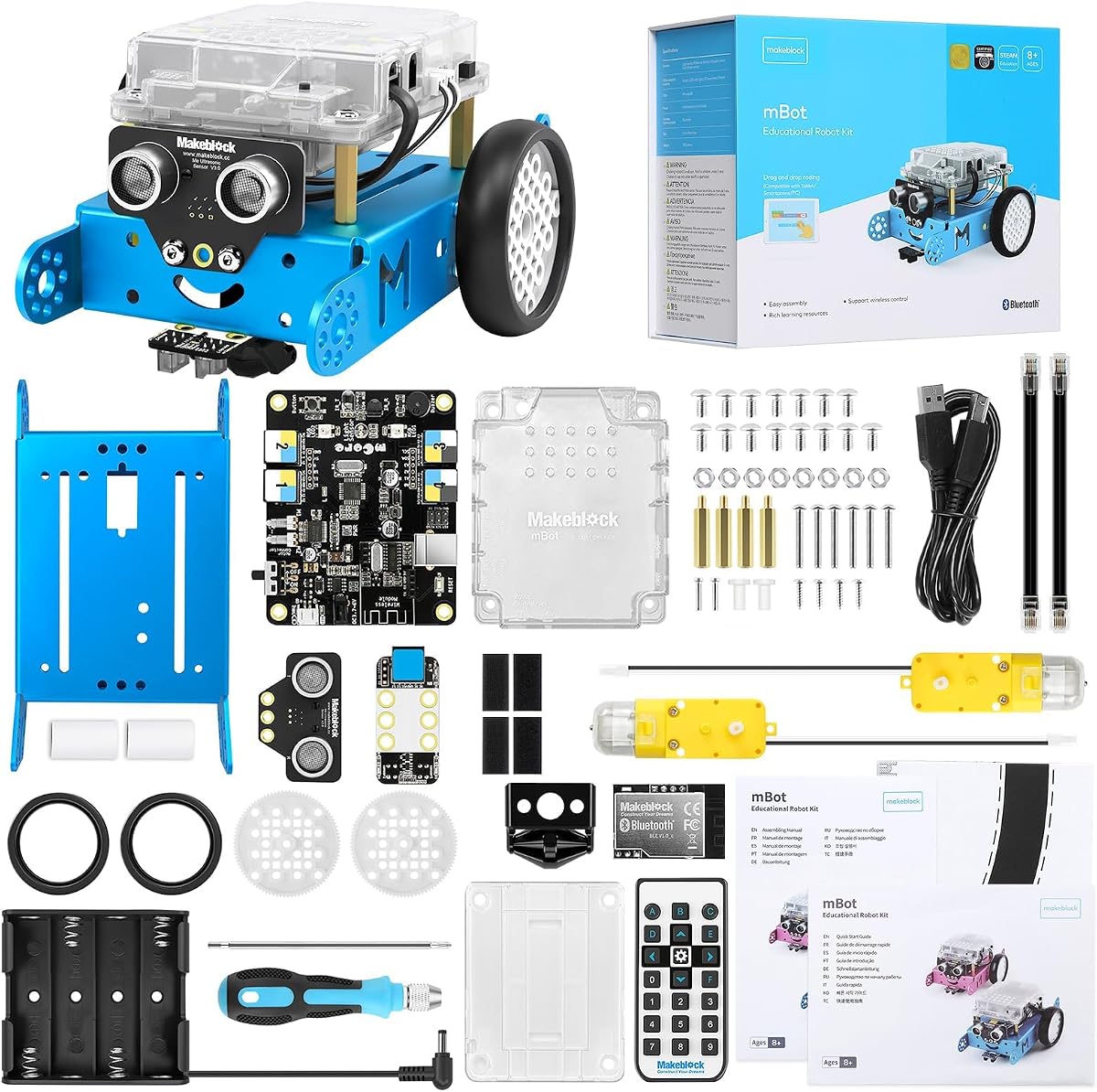
The Makeblock mBot is widely recognized for its exceptional educational design that guides children from visual coding to text-based programming. It excels at simplifying complex concepts through interactive lessons and structured tutorials. This kit is a favorite in schools because it is easy to deploy and encourages collaborative learning among peers.
We may earn a commission when you buy through this link, at no additional cost to you.
The build quality is impressive with metal components that withstand active play, and the assembly takes only about fifteen minutes. This allows kids to focus quickly on programming rather than construction. The mBlock software offers a seamless transition from drag-and-drop blocks to C++ based coding, supporting long-term skill development.
The main drawbacks are that batteries and remote batteries are not included in the box, which adds to the total cost. While minor, this can be inconvenient if you are ready to start immediately. However, the durability and software resources make up for these small additions, ensuring a robust learning experience.
We recommend this kit for families and educators looking for a proven STEM toy that scales with a child's ability. It works well for coding clubs and home projects where structured lessons are beneficial. The open-source nature ensures you will never run out of new challenges or community ideas.
The curriculum moves from simple blocks to complex Arduino code, providing a clear learning path that keeps students engaged over time.
You can connect over 100 electronic modules to expand the robot's functionality, allowing for endless creativity and project variety.
We may earn a commission when you buy through this link, at no additional cost to you.
This robot tank kit offers a rugged alternative to standard wheeled cars, featuring a stainless steel chassis and tracks for superior traction. It is perfect for those who want a more industrial feel and the ability to tackle slightly rougher surfaces. The kit includes a camera that can be adjusted during operation for better viewing angles.
We may earn a commission when you buy through this link, at no additional cost to you.
The build process is more involved than simpler kits, but the result is a sturdy and reliable robot. You can switch between various modes like auto follow and line tracking easily using the app or remote. The inclusion of block coding allows younger users to start quickly before moving to the Arduino IDE.
While the weight is higher than typical car kits, it provides stability and a more realistic tank experience. The complexity might be intimidating for very young children without help, but it is well within reach for motivated teens. The metal parts ensure the robot can withstand repeated builds and modifications.
Choose this kit if you want a durable robot that looks and feels like a real tank. It is great for outdoor play or for demonstrating mechanical engineering principles. The ability to adjust the camera and control modes gives it a professional edge for robotics enthusiasts.
The tank tracks allow the robot to climb small obstacles and move over uneven surfaces that wheels cannot handle effectively.
Ultrasonic and line sensors are integrated seamlessly, enabling precise navigation and autonomous pathfinding capabilities.
We may earn a commission when you buy through this link, at no additional cost to you.
The Tumbller kit is a unique project that focuses on control theory and balance, offering a different challenge from standard driving robots. It uses motion sensors to keep the robot upright, teaching valuable lessons in feedback loops and stabilization. It is a great way to understand how self-balancing scooters work.
We may earn a commission when you buy through this link, at no additional cost to you.
The kit includes a variety of play modes such as bounce mode and obstacle avoidance, keeping the project engaging after assembly. The guided tutorials help you wire and assemble the chassis efficiently. Once running, the robot can be controlled via IR or app, allowing for interactive play scenarios.
The main challenge is the calibration process, which requires patience to ensure the robot stays stable. Battery life is shorter due to the constant motor adjustments needed for balance. However, these are inherent to the physics of the project and do not detract from the learning experience.
We recommend this for learners interested in control systems and dynamic robotics. It is a standout choice for science fairs or home experiments where you want to demonstrate advanced engineering concepts. The ability to modify the code and expand with sensors makes it a powerful tool for education.
Building this robot gives you practical experience with PID controllers and real-time feedback systems used in modern technology.
Beyond balancing, you can switch modes for different challenges, ensuring the robot remains interesting for various skill levels.
We may earn a commission when you buy through this link, at no additional cost to you.
This ACEBOTT kit brings the advanced capability of Mecanum wheels to an affordable package, allowing the robot to move in any direction. This feature is rare in beginner kits and offers a unique way to learn about vector motion and complex control logic. It supports a variety of expansion packs that can alter the robot's form significantly.
We may earn a commission when you buy through this link, at no additional cost to you.
The tutorials are designed to tell a story, making the learning process more engaging and systematic. You can switch between various control methods and easily integrate additional sensors like cameras or robotic arms. The app provides intuitive control for immediate fun while you develop your own programs.
While the wheels provide great mobility, they can be noisier than standard rubber tires. Also, remember that batteries are not included in the package. Despite these minor issues, the versatility and control options make it a compelling choice for those who want more than basic forward and backward movement.
Ideal for students who want to explore multidirectional movement and advanced robotics. This kit is a great gift for teenagers and adults looking to dive deeper into coding. The expansion capabilities mean you can keep the robot relevant for years by adding new features.
Mecanum wheels allow sideways and diagonal movement, opening up new possibilities for navigation and precision control.
You can attach robotic arms or camera packs to customize the robot for specific tasks like manipulation or inspection.
We may earn a commission when you buy through this link, at no additional cost to you.
The LAFVIN R3 delivers a high-value experience by including a camera and FPV capabilities at a very competitive price point. It is an excellent choice for those who want modern features without a high investment. The assembly is designed to teach logical thinking and focus while building the robot from scratch.
We may earn a commission when you buy through this link, at no additional cost to you.
You can stream video to a mobile device and control the camera angles remotely. The kit supports multiple modes like obstacle avoidance and object following. It is part of an open-source ecosystem that provides free tutorials and code examples to help you get started quickly.
The wireless signal range may be limited in areas with heavy interference. The setup process requires some patience to connect to Wi-Fi correctly. These are minor trade-offs considering the low price and the advanced features you get compared to other kits in this segment.
We recommend this for budget-conscious buyers who still want a camera-equipped robot. It is great for beginners learning to code who want to explore video streaming. The affordability makes it accessible for schools or multiple students.
Experience the thrill of controlling a robot via video feed without spending a premium price for the capability.
Access a wealth of community projects and code to extend the robot's capabilities beyond the basic included examples.
We may earn a commission when you buy through this link, at no additional cost to you.
This versatile kit allows you to build different robot configurations including a robotic arm and a tank car. It is designed for teens and adults who want a multi-functional project that covers both manipulation and navigation. The robotic arm has 5 degrees of freedom, enabling detailed object handling tasks.
We may earn a commission when you buy through this link, at no additional cost to you.
The tank tracks ensure stability and traction on various surfaces including grass. The tutorial system is comprehensive with HD videos and step-by-step guidance to help you navigate the build. You can use both Scratch and Arduino for programming, making it accessible to a wide range of skill levels.
The complexity is higher than standard car kits, which might be challenging for younger kids without help. The software for advanced features may require some learning to use fully. However, the ability to switch between modes and the robust construction justify the effort for serious learners.
We recommend this for STEM training programs or families with older children interested in engineering. It is an excellent way to learn about degrees of freedom and mechanical design. The modular nature keeps the project fresh as you explore different build configurations.
Build a 5DOF arm to understand how robots pick and place objects, a fundamental skill in industrial automation.
The rugged tracks allow the robot to handle outdoor environments, expanding where you can use your creation.
We may earn a commission when you buy through this link, at no additional cost to you.
This kit is more than a robot; it is a full learning system with hundreds of components and dozens of projects. It covers basics to advanced topics like IoT integration making it a long-term resource. The video courses are designed by experts to ensure you learn effectively without getting stuck.
We may earn a commission when you buy through this link, at no additional cost to you.
You can build a smart car and many other projects like sensors and IoT devices. The sheer number of parts allows for deep experimentation and understanding of electronics. The learning path is progressive so you build skills step by step rather than jumping into complex builds.
The sheer volume of parts can feel overwhelming at first. You may need to organize the kit to manage the components easily. This is a minor issue given the educational value. The extensive documentation and support help mitigate this initial challenge.
We recommend this for dedicated learners who want a complete education in Arduino and electronics. It is ideal for a dedicated workspace where you can store the components. This kit is an investment in your skills that pays off over many months of projects.
Learn how to connect your robot to the internet and control it remotely, a key skill for modern smart home tech.
The video courses guide you through concepts logically ensuring you understand the why and how of every project.
We may earn a commission when you buy through this link, at no additional cost to you.
The mBot Ultimate is a premium kit designed for serious builders and professionals. It uses aluminum alloy parts for a robust build that feels like a real machine. The MegaPi control board can drive multiple motors and servos in sync allowing for complex builds like robotic arms or tanks.
We may earn a commission when you buy through this link, at no additional cost to you.
You can build ten different models from this single kit offering years of variety. It supports Python programming via Raspberry Pi making it a platform that can grow with advanced needs. The tutorials are detailed and cover everything from assembly to complex coding.
The price is high compared to other kits which may be a barrier for casual users. Batteries are also not included adding to the cost. However for those who want a durable and powerful system the investment is worth it for the longevity and performance.
We recommend this for schools or homes where multiple projects are planned over a long time. It is excellent for advanced makers who want industrial grade components. This kit is a long-term resource for education and professional prototyping.
High-strength aluminum parts ensure the robot can handle rigorous use and precise mechanical movements.
Expand your robot with machine vision and advanced AI tasks using a Raspberry Pi and Python language.
We may earn a commission when you buy through this link, at no additional cost to you.
The Freenove Hexapod offers a unique robotic experience with six legs that can move independently. This design allows for complex movements like twisting and crawling over obstacles. It is a fascinating project for those interested in biomimicry and advanced gait algorithms.
We may earn a commission when you buy through this link, at no additional cost to you.
The kit includes a remote and app control options making it easy to operate once built. The pre-written code library helps you get started without writing complex gait logic from scratch. The digital tutorial is detailed and provides clear instructions for assembly and wiring.
Calibrating the legs to move in sync can be tricky and requires attention to detail. The battery is not included which means you need to source one separately. Despite these minor challenges the unique form factor makes it a standout project for enthusiasts.
We recommend this for makers who want to explore walking robots. It is great for a workshop project where you can experiment with movement patterns. The remote and app control add a fun interactive layer to the build.
Learn to program complex walking patterns and adjust balance dynamically using the included code library.
This kit is inspired by arthropods providing a chance to study how biological systems move and adapt.
We may earn a commission when you buy through this link, at no additional cost to you.
Choosing the right robot kit involves considering your experience level, budget, and what you want to learn. This guide breaks down the key factors to help you make an informed decision.
Look for kits that match the builder's age and coding experience. Younger kids benefit from block coding and quick assembly while teens and adults can handle text coding and complex mechanics. Check the recommended age range in the product details to ensure the kit is appropriate.
For beginners start with kits that offer guided tutorials and simple wiring. Advanced users should look for expandability and compatibility with external sensors or boards.
Some kits require soldering while others use screw-together or keyed connectors. Consider how much time and effort you want to spend on building. Kits with detailed illustrated guides or video tutorials reduce frustration for first-time builders.
If you prefer a quick start look for kits that can be assembled in under an hour. For those who enjoy the build process complex mechanical chassis offer a rewarding challenge.
Most Arduino kits support the Arduino IDE which uses C++ code. Some also support block-based coding like Scratch or mBlock for easier entry. Ensure the software is compatible with your operating system and that documentation is available.
A kit that supports both block and text coding allows you to grow your skills over time. Look for open-source projects where you can access examples and libraries online.
A good robot needs sensors to interact with its environment. Common sensors include ultrasonic for obstacle avoidance, line trackers for path following, and cameras for vision. More sensors mean more complex and interesting projects.
Check if additional sensors can be added easily. Kits with open ports or expandable interfaces allow you to upgrade the robot later without buying a new one.
The physical build should be sturdy enough to support motors and sensors. Metal chassis are durable but heavier while plastic is light and cheaper. Consider where you plan to drive the robot indoors or outdoors.
Track systems offer better traction for rough terrain while wheels are faster for smooth surfaces. Choose a chassis design that matches your intended use case for better performance.
Some kits include rechargeable batteries while others require disposable cells. Rechargeable options are more convenient and eco-friendly. Check the battery voltage and capacity to ensure it powers the robot for a reasonable time.
Also note if the charging cable is included or if you need to buy one separately. Longer battery life means more time for testing without interruptions.
Look for brands with active communities and support forums. Having access to troubleshooting help and shared projects can save time and help you solve problems faster.
Kits with dedicated apps and regular updates ensure you can keep the robot functional for longer. Check reviews to see how responsive the manufacturer is to user issues.
Prices vary widely from under fifty dollars to hundreds. Consider the number of projects and components included to determine value. Sometimes a higher cost kit saves money by being more versatile.
Avoid the cheapest kits that lack essential features like sensors or documentation. A slightly higher investment often results in a better learning experience and longer usability.
Start by reading all assembly instructions carefully before beginning the build. Use the provided diagrams and videos to ensure motors and sensors are connected correctly. Take your time to align wheels and tracks so the robot drives straight and avoids mechanical wear.
Charge the batteries fully before first use and test the robot in a safe open area. Use the app or remote to control movement and observe how sensors respond. Modify the code examples to create custom behaviors like obstacle avoidance or specific paths.
Store the robot in a cool dry place and avoid exposing it to water or extreme heat. Clean sensors and wheels regularly to remove dust that could affect performance. If you add custom parts make sure they are securely fastened to prevent damage.
Yes most kits on this list support block-based programming which is visual and easy to learn. You can start with simple commands and transition to text-based coding as you grow more comfortable. Detailed tutorials guide you through every step so you do not need to be an expert.
Most kits are designed for ages 8 and up with adult supervision for younger children. Some advanced kits with complex mechanics are better suited for teens and adults. Always check the manufacturer's age recommendations to ensure safety and appropriate skill levels.
Some kits include rechargeable batteries but others may require you to purchase them separately. Always check the product specifications to see what is included. Disposable AA or AAA batteries are common requirements if a rechargeable pack is not provided.
Many kits offer open ports or compatibility with expansion packs for sensors like cameras or arms. Look for models with open-source designs which allow you to add components easily. Expansion capabilities extend the learning value and allow for more complex projects.
You usually need internet to download software but the actual coding and uploading can be done offline. Some features like FPV streaming require a Wi-Fi connection to transfer video data. Check the specific requirements of the app you plan to use.
You will need a clean flat workspace like a desk to lay out parts and tools. Larger kits with more components require more room for organization. Ensure you have good lighting and access to a power outlet for your computer during assembly.
The top picks like the ELEGOO UNO R3 and Makeblock mBot offer a balance of features and ease of use for most learners. Kits like the Hexapod and mBot Ultimate provide specialized experiences for those seeking advanced mechanical challenges. Choose a kit that matches your goals and technical comfort level.
Prioritize kits with strong community support and expandable features to maximize long term value. A good robot should allow you to add new sensors or change configurations as your skills improve. This ensures your investment remains useful as you progress to more complex tasks.
Always check current availability and prices before purchasing as product versions may change. Read recent reviews to ensure compatibility with your devices and operating systems. With the right robot kit you can explore the exciting world of engineering and coding at your own pace.