
Creality Ender 3 V3 SE
4.9Editor score
CR Touch auto leveling
250mm/s high speed
Bundle with filament packs
This guide compares the best 3D printer for beginners based on speed, ease of use, and print quality to help you choose the right model for your needs.
Entering the world of additive manufacturing requires a reliable machine that balances performance with user-friendly operation. A good 3D printer for beginners should minimize setup time and maximize successful prints right from the start.
We evaluated ten top-rated models focusing on auto-leveling features, build volume, and community support. Our selection includes machines designed for rapid prototyping as well as those optimized for creative home projects.
Each pick highlights specific strengths like multi-color capability or quiet operation to match different skill levels. Please note that availability and costs fluctuate frequently across online retailers and marketplaces.
4.9Editor score

4.7Editor score

4.2Editor score
This table provides a side-by-side overview of key specifications for all ten selected models to help you quickly identify the right fit.





The Bambu Lab A1 stands out as a top choice for those entering the world of 3D printing. With a high rating of 4.7 stars it delivers exceptional ease of use and performance that rivals more expensive machines.
We may earn a commission when you buy through this link, at no additional cost to you.
Its standout feature is the full-auto calibration system which eliminates the need for manual bed leveling or Z-offset adjustments. Users can start printing within minutes of unboxing thanks to its smart algorithms that ensure perfect first layers consistently.
While the base unit does not include the AMS for multi-color printing this remains a viable trade-off for beginners focused on single-material prototyping. The price point is competitive given the speed and reliability offered by the internal hardware.
We recommend this model for educators and hobbyists who want a reliable workhorse that minimizes troubleshooting. Its quiet operation and user-friendly design make it ideal for home environments where noise reduction is a priority.
The system automatically checks nozzle and bed alignment before every print to ensure consistent adhesion and dimensional accuracy without user intervention.
Active noise canceling technology reduces motor sounds while the high acceleration rate allows for rapid completion of small to medium sized projects.
We may earn a commission when you buy through this link, at no additional cost to you.
The Creality Ender 3 V3 SE offers incredible value by combining fast printing speeds with essential automation features. It holds an impressive 4.9 star rating from users who appreciate the bundle including filament and reliable mechanical upgrades.
We may earn a commission when you buy through this link, at no additional cost to you.
Key strengths include the CR Touch auto leveling sensor and the Sprite direct extruder which handle filament flow efficiently. The dual Z-axis shafts reduce wobbling ensuring that prints remain accurate even at the supported 250mm/s speed.
Unlike fully assembled models this unit requires some setup which can be a learning opportunity for those interested in how the machine works mechanically. The bundle content helps offset the cost of initial materials needed to start printing immediately.
This printer is highly recommended for students and hobbyists on a tight budget who want performance without sacrificing quality. Its robust construction and community support make it a safe long-term investment for growing skills.
The dual Z-axis lead screws prevent vertical wobbling during movement which improves layer consistency and overall print finish quality.
The lightweight Sprite extruder provides strong gripping force to prevent slippage when using flexible materials like TPU or soft PLA.
We may earn a commission when you buy through this link, at no additional cost to you.
The Bambu Lab P1S Combo represents a high-end solution that brings professional capabilities to home users. With a rating of 4.2 stars it combines speed and material versatility in a package that is ready to use right out of the box.
We may earn a commission when you buy through this link, at no additional cost to you.
Its most significant advantage is the AMS system which allows for printing with up to sixteen different colors simultaneously. The enclosed design also makes it suitable for advanced filaments that require stable temperatures during the printing process.
Beginners interested in complex visual projects will find the multi-color capability transformative for creating models that require distinct hues or materials without post-processing. The cost reflects these advanced features and is justified by the time saved in assembly and calibration.
We suggest this model for users who plan to invest seriously in 3D printing and want room to grow. Its robust features ensure that you will not need to upgrade quickly as your skills and project needs expand.
The AMS module manages up to four spools at once enabling seamless transitions between colors and materials during a single print job.
The sealed body maintains consistent internal temperatures which reduces warping and supports materials like ABS that are difficult to print on open frames.
We may earn a commission when you buy through this link, at no additional cost to you.
The FLASHFORGE Adventurer 5M focuses on speed and efficiency with a CoreXY structure and a 600mm/s travel speed. It carries a rating of 3.9 stars which indicates mixed experiences regarding stability and software compatibility for new users.
We may earn a commission when you buy through this link, at no additional cost to you.
Key features include a quick 3-second nozzle change mechanism and a high flow extruder that supports fast material deposition. The auto leveling system ensures the bed is ready for printing without tedious manual adjustments which saves valuable setup time.
While the high speed is attractive for rapid prototyping it may introduce vibration issues that affect surface quality on delicate parts. Users should expect to tune settings carefully to balance speed with the resolution required for their specific projects.
This model is suitable for those who need to produce prototypes quickly and have some experience with tuning printer settings. It offers a balance of performance and ease of use but requires patience to achieve consistent results.
The detachable nozzle system allows users to switch between different sizes in seconds which helps optimize for detail or speed based on the part.
Remote monitoring via the Flash Studio app lets users check progress and receive alerts on their phones to manage multiple jobs efficiently.
We may earn a commission when you buy through this link, at no additional cost to you.
This Mini 3D Printer is designed specifically for younger users or those with limited workspace who want a complete starter experience. It has a rating of 4.4 stars from users who appreciate the simplicity and included accessories.
We may earn a commission when you buy through this link, at no additional cost to you.
The main benefits are that it is fully assembled and includes a roll of filament and SD card so printing can begin immediately. The auto leveling feature simplifies the process ensuring that beginners do not get frustrated with bed adhesion issues.
The compact size makes it easy to place on a desk but limits the size of objects that can be printed. While this is a constraint it is acceptable for toys and small projects that are the primary focus for this target audience.
We recommend this unit for schools or families introducing children to 3D printing in a safe and supported way. The warranty and support options provide peace of mind for parents who want a reliable educational tool.
The inclusion of filament and tools removes the need for additional purchases before the first print which helps maintain initial excitement.
With a precision of 0.01mm this compact machine can still produce detailed parts suitable for small mechanical components or figurines.
We may earn a commission when you buy through this link, at no additional cost to you.
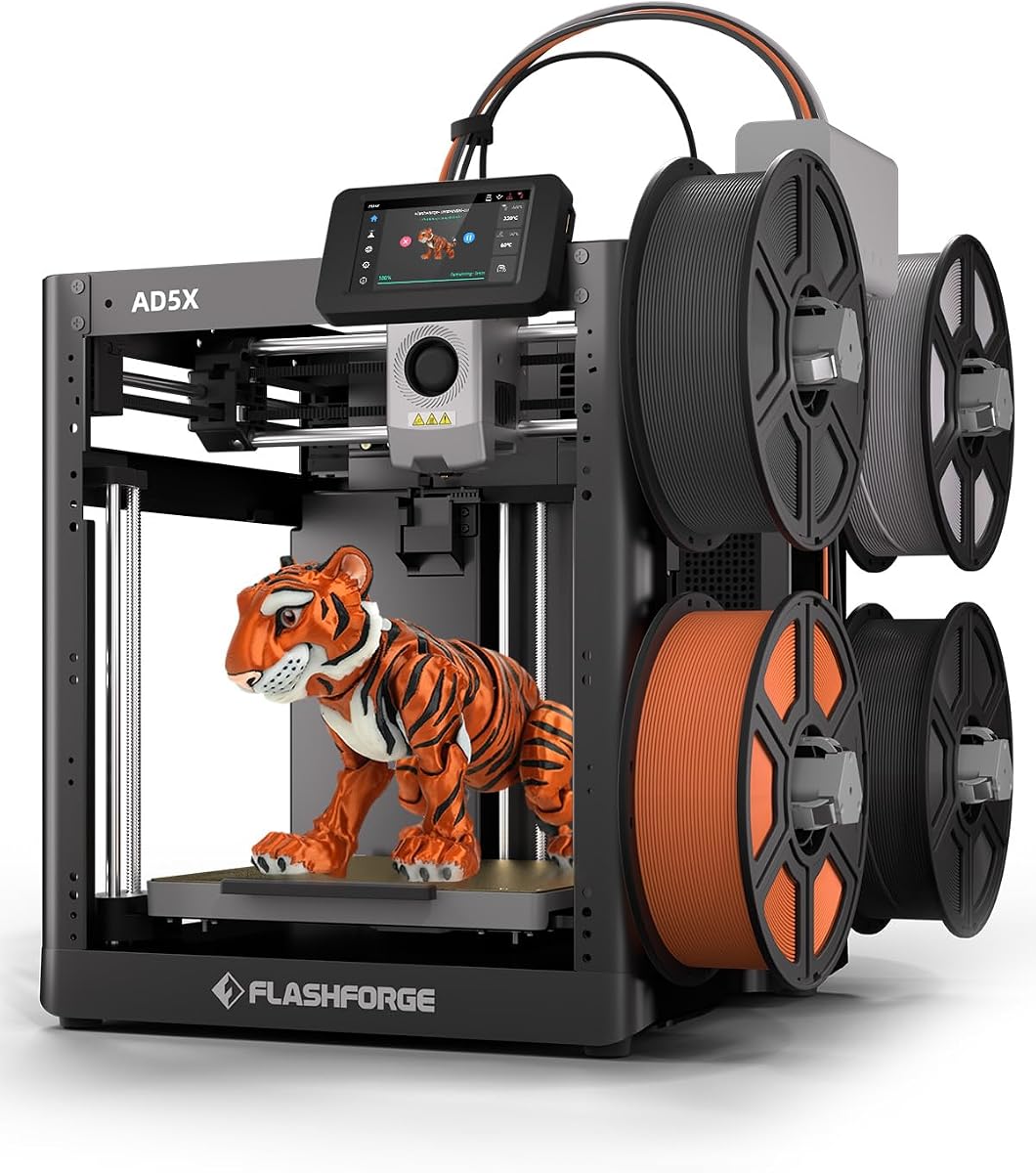
The FLASHFORGE AD5X brings multi-color capabilities to a faster CoreXY platform at a competitive price point. It has a rating of 3.9 stars reflecting that while performance is strong some users face challenges with software consistency.
We may earn a commission when you buy through this link, at no additional cost to you.
Key strengths include the ability to print up to four colors simultaneously which adds visual depth to models without complex post-processing. The 1-click auto leveling and high extruder temperature make it versatile for various materials.
However the multi-color implementation may require calibration to ensure perfect alignment between color changes. Beginners should be prepared to engage with support resources to optimize the printing process for multi-material jobs.
This printer is a good option for hobbyists who want to experiment with color without buying a premium multi-color system. It balances advanced features with accessibility making it a strong contender in the mid-range market.
Up to four simultaneous colors allow for rich detail on models such as maps or figures that require distinct color separation.
The system includes vibration compensation to maintain print quality even at high speeds where motion artifacts might otherwise appear.
We may earn a commission when you buy through this link, at no additional cost to you.
The AOSEED AI 3D Printer is a unique solution designed to integrate artificial intelligence into the creative process for children. With a rating of 4.5 stars it focuses on ease of use and safety to encourage STEM learning at home.
We may earn a commission when you buy through this link, at no additional cost to you.
The AI doodle feature allows kids to generate 3D models from simple text or image prompts which removes the barrier of complex design software. The enclosed design ensures that moving parts are safe for curious fingers during operation.
Although it only supports single color printing the included access to 8000 plus pre-tested models provides endless inspiration. The bundle includes filament and tools making it a complete package for immediate creative projects.
We suggest this model for parents who want an engaging and educational toy that fosters creativity without a steep learning curve. The AI tools make it easy for young users to visualize their ideas quickly.
Text or image prompts can generate printable files directly turning imagination into tangible objects without technical design skills.
The enclosed structure prevents access to hot zones while the pinch resistant design ensures that handling during prints is safe.
We may earn a commission when you buy through this link, at no additional cost to you.
The Bambu Lab A1 mini brings the reliability of the larger A1 model into a compact form factor suitable for desks. It holds a rating of 4.4 stars from users who value the automatic calibration and included LED project kit.
We may earn a commission when you buy through this link, at no additional cost to you.
Its primary strengths are the automatic calibration system which ensures consistent results and the quiet operation that fits well in shared spaces. The included LED lamp kit provides a clear and practical project to start with immediately.
The build volume is smaller than standard models limiting the size of single objects but perfect for small prototypes. The price remains competitive for a fully featured machine that minimizes the need for troubleshooting.
This unit is ideal for apartment dwellers or students who need high quality prints without occupying a large workspace. It offers a reliable entry point into 3D printing with the backing of a robust software ecosystem.
The small footprint allows placement on a desk while the internal components remain high quality for consistent print performance.
The included LED lamp kit provides a practical project that demonstrates lighting and assembly skills in one package.
We may earn a commission when you buy through this link, at no additional cost to you.
The FLASHFORGE AD5M combines speed and durability with an all-metal CoreXY structure that supports high acceleration. It has a rating of 4.3 stars reflecting satisfaction with its build quality and ease of maintenance.
We may earn a commission when you buy through this link, at no additional cost to you.
Key advantages include the one-click calibration system which reduces setup time and the quick-swap nozzle that simplifies changes. The resume print feature is valuable for preventing loss of work if power interruptions occur during long jobs.
The flexible PEI plate ensures that models are removed easily which reduces the risk of damaging the print or the bed surface. These features make it a reliable choice for users who prioritize efficiency and robustness.
We recommend this printer for those who need to produce parts regularly without constant manual adjustments. It strikes a good balance between performance and user convenience for a wide range of applications.
The all-metal CoreXY structure provides stability that allows for high speeds without sacrificing precision or structural integrity over time.
Bending the PEI plate allows for effortless removal of parts which saves time and reduces the chance of print damage.
We may earn a commission when you buy through this link, at no additional cost to you.
The Bambu Lab P1S is a ready-to-use machine that supports a wide range of materials including ABS thanks to its enclosed design. It holds a high rating of 4.5 stars for its reliability and speed.
We may earn a commission when you buy through this link, at no additional cost to you.
Its main advantages are the enclosed body which maintains temperature and the automatic bed leveling which ensures consistent first layers. Users can set it up quickly and start printing complex parts within minutes.
While the base model is monochrome it is designed to be expandable with the AMS system for multi-color capabilities. This modular approach allows beginners to start simple and upgrade as their needs grow.
We suggest this model for users who need a reliable machine for both standard and engineering materials. The enclosure makes it suitable for more advanced projects that require temperature control.
The sealed body keeps heat in to prevent warping which is essential for printing materials like ABS or ASA successfully.
Users can have the printer fully configured and ready to print within fifteen minutes of unboxing which saves time.
We may earn a commission when you buy through this link, at no additional cost to you.
Selecting the right 3D printer involves evaluating features that match your skill level and project goals.
Auto leveling systems automatically adjust the bed height to ensure the first layer adheres properly. For beginners this feature eliminates the need for manual calibration which can be time-consuming and frustrating.
Look for printers that advertise fully automatic calibration or CR touch sensors to reduce setup time.
The build volume determines the maximum size of objects you can print in one piece. Smaller volumes are more compact and affordable but limit the size of your creations.
Consider your available space and typical project sizes to decide between a small desktop unit and a larger printer.
Higher print speeds allow you to finish prototypes and parts faster. Modern printers offer speeds over 200mm/s but quality must be balanced with speed.
Beginners should look for consistent high speeds with vibration compensation to ensure quality is not compromised.
Enclosed printers provide a stable temperature environment which is beneficial for advanced materials like ABS. Open frames are generally more affordable and easier to cool.
Choose an enclosed model if you plan to use heat-sensitive materials frequently.
Maintenance includes tasks like changing nozzles and cleaning beds. Printers with quick-swap nozzles and PEI beds simplify these tasks.
Look for designs that allow easy access to critical components to extend the life of your machine.
Software controls slicing and printer settings. A user-friendly interface and cloud connectivity can improve the workflow.
Choose a printer with robust software support to minimize technical hurdles during operation.
Not all printers can handle every type of filament. High temperature extruders support advanced materials while others are limited to PLA.
Ensure the printer supports the materials you intend to use for your projects.
A strong user community provides valuable tips and troubleshooting advice. Look for models with active forums and responsive customer support.
This support network is crucial for overcoming challenges as you learn to operate your printer.
Before printing ensure the build plate is clean and calibrated. Use the auto leveling feature or manual adjustments to guarantee a flat surface for the first layer.
After printing allow the bed to cool completely before removing parts to avoid warping. Use a scraper or spatula gently to prevent scratching the surface.
Regularly clean the nozzle and check for clogs to maintain print quality. Store filaments in dry environments to prevent moisture absorption which affects printing.
The Bambu Lab A1 is often considered the easiest due to its full-auto calibration and quick setup. It requires minimal user intervention to produce high-quality prints immediately.
Some models like the Mini 3D Printer for Kids come fully assembled for immediate use. Others like the Ender 3 V3 SE require some assembly which can be a great learning experience.
Yes when using enclosed printers designed for kids like the AOSEED AI. These models prevent access to hot zones and move parts for safety during operation.
PLA is the best filament for beginners because it is easy to print and does not require high temperatures. It is available in many colors and is environmentally friendly.
Print times vary based on size and speed settings. Small objects can take 20 minutes while larger detailed pieces may take several hours to complete.
Yes some printers like the Bambu Lab P1S Combo support multi-color printing with an AMS system. This allows for complex designs with different materials in one job.
Our top picks highlight a range of options from the reliable Bambu Lab A1 to the budget-friendly Creality Ender 3 V3 SE. Each offers distinct advantages for different skill levels.
Prioritize auto leveling and reliability when choosing your first machine to ensure a smooth learning experience. These features reduce frustration and help you focus on creativity.
Remember to check current prices and availability as they change frequently. Your ideal printer will depend on your specific project needs and space constraints.