
M-AUDIO Keystation 88 MK3
4.5Editor score
Semi-weighted key action
Plug-and-play USB connectivity
Includes MPC Beats software
Discover the top 88 Key Weighted MIDI Controllers for 2026. Our expert guide compares features, key feel, and DAW integration to help you choose the perfect
Choosing the right 88 Key Weighted MIDI Controller is crucial for producers and pianists seeking authentic expression. These devices bridge the gap between digital workstations and acoustic instruments, offering full-range playability with tactile feedback that inspires creativity.
We evaluated ten leading models based on key action quality, connectivity options, software integration, and overall build. Our comparison focuses on how each controller performs in real-world studio scenarios, ensuring you find a tool that matches your specific musical needs and workflow.
Each selection highlights unique strengths, from budget-friendly semi-weighted options to premium hammer-action keyboards. Prices and availability fluctuate frequently, so please verify current details on the product pages before making your final decision to ensure you get the best value.
4.5Editor score

4.6Editor score

4.3Editor score
This side-by-side comparison outlines the core specifications and unique selling points of each model. Use this table to quickly identify which controller aligns with your budget, software ecosystem, and performance requirements.



The Novation Launchkey 88 [MK3] stands out as a top contender for producers needing deep software integration. With a 4.6 rating, it delivers a premium playing experience through its full-size semi-weighted keys and responsive pads.
We may earn a commission when you buy through this link, at no additional cost to you.
Its standout feature is the seamless DAW integration, allowing instant access to transport controls and plugin parameters without complex setup. The powerful arpeggiator with Strum Mode unlocks new melodic possibilities, while Creative Scale and Chord Modes simplify complex harmonies for composers.
While it lacks full weighted action and aftertouch, the keybed remains expressive enough for most electronic and hybrid production workflows. The Custom Modes feature further extends control over external synths, ensuring flexibility across different hardware setups.
This controller is ideal for electronic producers and beat makers who prioritize workflow speed and software connectivity. If you need a reliable hub for your DAW that feels great to play, this model offers an excellent balance of features and usability.
Custom scripts provide immediate control over your specific DAW, reducing menu diving and keeping you in the creative flow.
Built-in scale and chord modes let you experiment with melodies and harmonies even if you are not a trained pianist.
We may earn a commission when you buy through this link, at no additional cost to you.
The Arturia KeyLab 88 mk3 delivers a premium experience with its fully weighted hammer-action keys. Rated 4.3, it appeals to pianists and composers who demand a realistic playing experience across the full 88-key range.
We may earn a commission when you buy through this link, at no additional cost to you.
Its 12 pressure-sensitive performance pads offer dynamic control for triggering samples or clips. The inclusion of USB-C power streamlines setup, and the dedicated sheet music stand adds practical value for traditional players. This controller bridges the gap between studio gear and performance instruments effectively.
Trade-offs include the weight and cost, which may not suit mobile users or tight budgets. However, for a permanent studio installation, the build quality and key action justify the investment. It stands out as a serious tool for professional production.
Consider this if you need a high-end controller that mimics an acoustic piano. The combination of hammer action, modern connectivity, and thoughtful extras makes it a robust choice for serious music creators looking for longevity and performance.
The fully weighted keys replicate the resistance of an acoustic piano, providing true dynamic expression for classical and jazz styles.
USB-C power reduces cable clutter and ensures reliable data transfer, aligning with current laptop standards.
We may earn a commission when you buy through this link, at no additional cost to you.
The M-AUDIO Keystation 88 MK3 is an accessible entry point for beginners needing a full 88-key range. With a 4.5 rating, it offers a semi-weighted action that feels smooth and responsive for most users.
We may earn a commission when you buy through this link, at no additional cost to you.
Its plug-and-play USB connectivity means no drivers or power supply are required, making it easy to start creating immediately. The slimline design fits comfortably on small desks, and the included software like MPC Beats adds immediate value without extra cost.
While it lacks advanced features like aftertouch or extensive modulation controls, it covers essential needs like volume faders and transport buttons. This simplicity is a benefit for those who want to focus on playing rather than tweaking parameters.
This controller is perfect for students, hobbyists, or anyone needing a reliable full-range keyboard on a budget. If your priority is straightforward MIDI control and portability, this model provides excellent functionality for the price.
USB bus power and driver-free operation allow you to connect and start playing instantly on any computer.
The slim profile ensures it fits easily in smaller home studios without compromising on the full 88-key range.
We may earn a commission when you buy through this link, at no additional cost to you.
The M-AUDIO Hammer 88 Pro targets advanced users with graded hammer action and aftertouch support. It aims to deliver a traditional piano feel with modern control surfaces for complex productions.
We may earn a commission when you buy through this link, at no additional cost to you.
Its Native Kontrol Standard integration offers seamless control over Native Instruments presets. The 16 RGB drum pads and 9 faders provide extensive tactile options for mixing and beat production, while auto-mapping simplifies plugin configuration.
However, user ratings suggest variability in build consistency or feature execution. The weight can be cumbersome for transport, and the learning curve for all controls may be steep for some users.
This model is best for those deeply invested in the Native Instruments ecosystem. If you require aftertouch and extensive physical control, it offers a comprehensive package, though you should weigh the complexity against your workflow needs.
Partnered control with Native Instruments ensures you can browse and tweak presets directly from the keyboard.
Multiple faders, knobs, and pads allow simultaneous control over many parameters during live performance or mixing.
We may earn a commission when you buy through this link, at no additional cost to you.
The Arturia KeyLab Essential mk3 features hybrid synth-piano keys that offer a unique playing experience. Rated 4.4, it balances piano feel with synth responsiveness for versatile performance.
We may earn a commission when you buy through this link, at no additional cost to you.
Its Scale Mode, Chord Mode, and Arpeggiator enhance composition intuitively. Custom DAW integration and an LCD screen for real-time feedback make navigating sounds and settings easy, while the included Analog Lab Pro provides access to 2000+ presets.
The waterfall keybed might not appeal to traditional pianists, but it suits synth and electronic players well. It serves as a creative tool rather than a pure emulation of acoustic instruments.
Choose this if you want a modern interface with creative composition aids. The software bundle and visual feedback make it a strong option for producers who value flexibility and inspiration over strict traditional key action.
Chord and scale modes help you unlock complex musical ideas quickly, making songwriting more accessible.
The bright LCD screen gives you clear parameter readouts, reducing guesswork during adjustments.
We may earn a commission when you buy through this link, at no additional cost to you.
The Studiologic SL88 MK2 focuses on a solid weighted keybed and practical control layout. With a 4.5 rating, it emphasizes reliability and straightforward MIDI management for users.
We may earn a commission when you buy through this link, at no additional cost to you.
Its onboard display allows independent configuration without needing a computer. The 7 encoders offer tactile control over parameters, and Numa Player compatibility ensures seamless integration with its own sound engine.
While it lacks extensive creative tools like arpeggiators, it remains a robust tool for pure MIDI control. The build quality and key response are highly regarded by users who prioritize playability and function.
Ideal for performers who need a no-nonsense controller, this model delivers on core essentials. If you value clear visual feedback and durable keys over bells and whistles, it is a dependable choice.
Use the onboard display to adjust settings and map controls without opening any software on your computer.
Encoders and switches are well-placed, allowing quick adjustments during live sets or recording sessions.
We may earn a commission when you buy through this link, at no additional cost to you.
The YAMAHA P71 is designed primarily as a digital piano with weighted action, rated 4.7 for its touch-sensitive keys. It replicates an acoustic piano experience effectively, focusing on core playing functionality.
We may earn a commission when you buy through this link, at no additional cost to you.
It offers 10 unique voices and a Dual Mode to blend sounds like piano and strings. The simplicity of one-button operation keeps you focused on music, and the included sustain pedal adds necessary expression for performances.
While it lacks the extensive controls and MIDI features of dedicated controllers, it serves well for pianists needing a simple interface. The streamlined design avoids complexity, making it accessible for all skill levels.
Choose this if your priority is a quality keybed and sound over complex MIDI control. It is an excellent option for those who want a straightforward digital piano experience that also works as a MIDI controller.
The weighted action mimics real keys, providing the resistance and feedback needed for expressive performance.
Dual Mode lets you combine two voices for a richer, more immersive sound during play.
We may earn a commission when you buy through this link, at no additional cost to you.
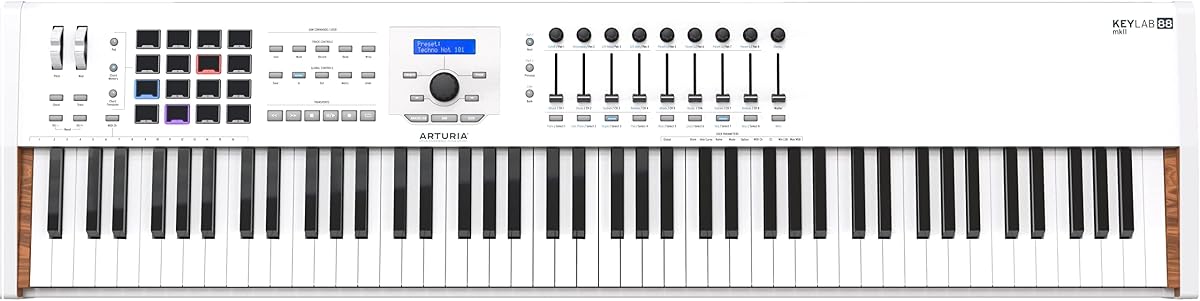
The Arturia KeyLab 88 MkII combines a Fatar TP/100LR keybed with extensive control options. Rated 4.6, it is a well-rounded controller that balances playability with production tools.
We may earn a commission when you buy through this link, at no additional cost to you.
It includes 16 RGB-backlit pads, 9 faders, and 9 rotary knobs for tactile MIDI control. Aftertouch support adds expressive depth, and Analog Lab V software is included to expand your sonic palette.
Keep in mind that a stand is not included, so factor that into your purchase. The layout can be busy for beginners, but experienced users will appreciate the depth of customization available.
This is a solid choice for producers needing a full set of controls and a premium keybed. If you want a versatile keyboard that acts as a studio hub, the MkII delivers strong performance.
The Fatar TP/100LR keybed is respected for its balanced hammer action, offering a natural piano feel.
With 9 faders and 9 knobs, you have direct control over mix and effect parameters without screen diving.
We may earn a commission when you buy through this link, at no additional cost to you.
The white version of the Arturia KeyLab 88 mk3 offers the same high-quality hammer action and controls as the black model. It suits studios prioritizing visual aesthetics without sacrificing functionality.
We may earn a commission when you buy through this link, at no additional cost to you.
It features 12 pressure-sensitive performance pads and USB-C power for modern connectivity. The included sheet music stand supports traditional playing styles, and the white finish adds a clean, professional look to any setup.
With a slightly lower rating than the black variant, it is essential to verify current production standards. The core performance remains identical, so choose this if you prefer a lighter visual presence.
This variant is perfect for creators who want a stylish centerpiece in their studio. If the standard model works for you, the white version provides the same capabilities with a distinct, polished appearance.
Matching your gear to your studio aesthetic can boost inspiration and keep your workspace visually organized.
Despite the color difference, you get the exact same premium features and performance as the standard version.
We may earn a commission when you buy through this link, at no additional cost to you.
The Roland A-88MKII features the PHA-4 keyboard and is built with wood and premium materials for longevity. It aims for unmatched playability and durability for serious musicians.
We may earn a commission when you buy through this link, at no additional cost to you.
It supports MIDI 2.0 readiness and includes customizable zones and an onboard arpeggiator. The thin design fits shallow studio spaces, and USB-C connectivity ensures modern bus power capabilities for simpler setups.
The high price point and mixed reviews suggest it is a niche product. While the keybed is exceptional, users should consider if the extra cost aligns with their specific need for premium construction.
This controller is best for those who value long-term durability and superior key feel. If you are willing to invest in a high-end instrument that lasts, it offers a robust, premium experience.
Being MIDI 2.0 ready ensures your controller remains compatible with evolving standards for years.
Wood and premium materials give it a professional look and feel that lasts through years of use.
We may earn a commission when you buy through this link, at no additional cost to you.
Selecting the right controller involves understanding your specific workflow, budget, and performance needs. This guide breaks down the critical factors to consider before making your purchase.
Key action determines how the keys respond when pressed. Fully weighted hammer action mimics an acoustic piano, while semi-weighted keys are lighter and suited for synth work. Consider your musical style and whether you need a traditional piano feel.
Choose fully weighted for classical or jazz, and semi-weighted for electronic or fast-paced production.
Look for faders, knobs, and pads that match your DAW workflow. Assignable controls allow you to map parameters quickly, reducing reliance on mouse navigation. Pads are useful for triggering samples, launching clips, or playing percussion.
More controls offer flexibility but may increase complexity; choose based on your actual usage.
Deep integration means custom scripts map transport, volume, and plugin controls automatically. This saves setup time and keeps you focused on creation. Ensure the controller supports your specific software like Ableton, Logic, or FL Studio.
Always verify mapping scripts are available for your preferred DAW before purchasing.
Premium materials like wood or high-grade plastics ensure durability and resistance to wear. Consider if you will transport the unit or leave it in a fixed studio location. Heavier units may be more stable on a desk.
Prioritize build quality if you need a long-term investment for professional use.
USB connectivity is standard, but USB-C offers modern power and data transfer. Some models include traditional MIDI ports for external hardware integration. Bus power simplifies setup by eliminating extra power bricks.
Check your interface ports to ensure compatibility and convenience for your setup.
Manufacturers often include DAWs, instruments, or plugins to add value. These can save money and expand your sound library immediately. Verify the software is active and usable for your specific needs.
Treat included software as a bonus rather than the main reason to buy.
Prices vary widely based on features and materials. Determine your maximum spend and compare features within that range. Sometimes mid-range models offer the best balance of quality and cost for most users.
Avoid overspending on features you will not use regularly to maximize value.
Aftertouch adds expressive pressure sensitivity after a key is pressed, allowing for modulation like vibrato. Not all controllers support this feature. If dynamic expression is vital for your music, prioritize models with this capability.
Look for explicit aftertouch support if you need nuanced sound control during performance.
Connect your controller using a USB cable to your computer and ensure your DAW recognizes it. If using bus power, ensure your laptop provides sufficient power; otherwise, use the dedicated power adapter if required.
Install any necessary drivers or DAW scripts provided by the manufacturer to unlock all features. Calibrate the keys and controls through the controller settings or software if available to ensure accurate response.
Keep the controller clean with a soft cloth and avoid exposure to humidity or extreme temperatures. Store it in a dry place or a padded case when not in use to protect the keys and mechanical components.
Yes, 88 key MIDI controllers are excellent for beginners who want to learn piano fundamentals. They provide a full range of notes, allowing you to play without limitations. Many models come with educational software to help you get started quickly and effectively.
Weighted keys use a hammer mechanism to mimic the resistance of an acoustic piano, while semi-weighted keys use springs for a lighter feel. Weighted keys are better for classical training, while semi-weighted keys are popular in electronic music for speed and flexibility.
No, most controllers work immediately with standard DAWs via USB. However, manufacturers often include software bundles like synthesizers or sample libraries to enhance your experience. You can use them without this extra software if you prefer.
Yes, most models support USB bus power, meaning they draw power directly from your laptop. Just ensure your USB port provides enough power. If not, a powered USB hub or external power supply may be needed.
Pads are velocity-sensitive buttons used to trigger samples, drums, or MIDI notes. They are common in beat making and live performance to add percussion elements. Some allow velocity and pressure sensitivity for dynamic control.
Aftertouch allows for dynamic modulation by pressing harder after a key is struck. It is useful for adding expression like vibrato or filter sweeps. While not essential for all users, it is a valuable feature for expressive performance.
Many controllers come with pre-mapped scripts for popular DAWs. Install the manufacturer's software to enable these scripts. For custom needs, use the DAW's learning mode to assign parameters to knobs and faders manually.
The Novation Launchkey 88 [MK3], Arturia KeyLab 88 mk3, and M-AUDIO Keystation 88 MK3 stand out for their balance of features and usability. Each serves different needs, from deep integration to premium action and budget accessibility.
Prioritize the key action type that matches your playing style and ensure the DAW integration simplifies your workflow. Consider whether you need pads, faders, or aftertouch to avoid paying for unused features.
Prices and availability change regularly so check the current listings before purchasing. Your ideal controller is the one that inspires creativity without hindering your daily production routine.