
Mcbazel Surecom SF401 Plus
4.1Editor score
Measures 27MHz to 3000MHz
Includes CTCSS and DCS decoders
Portable design with four-button control
This guide compares the best frequency counter for ham radio options including portable meters and spectrum analyzers to help you choose the right tool for
Finding the right frequency counter for ham radio is essential for anyone who wants to maintain accurate equipment and ensure reliable communications across all bands.
We have carefully reviewed ten top-rated products ranging from budget-friendly handheld meters to advanced GPS-disciplined counters to help you make an informed decision for your setup.
Each pick highlights key features and performance metrics so you can compare options easily though remember that product availability and pricing may change over time.
4.1Editor score

4.4Editor score

5.0Editor score
The following table provides a side-by-side comparison of all ten products so you can quickly evaluate their capabilities and suitability for your specific radio needs.


The Mcbazel Surecom SF401 Plus stands out as an accessible entry point for ham radio operators needing a reliable frequency counter without breaking the bank.
We may earn a commission when you buy through this link, at no additional cost to you.
Its ability to measure from 27MHz up to 3000MHz covers most amateur bands and even CB frequencies while the built-in CTCSS and DCS decoders add significant utility.
While the temperature compensated oscillator offers decent stability users should note that extreme temperatures can affect accuracy slightly but this is acceptable for the price.
This unit is ideal for beginners or hobbyists who want a straightforward tool to verify walkie talkie frequencies and maintain their equipment effectively.
Measuring from 27MHz to 3000MHz ensures you can test everything from CB radios to amateur VHF UHF transceivers.
Its compact size and included antennas make it easy to carry into the field for on-the-spot frequency checks.
We may earn a commission when you buy through this link, at no additional cost to you.
This variant of the SF401 Plus offers nearly identical functionality to the Mcbazel version making it a great alternative choice for those comparing listings.
We may earn a commission when you buy through this link, at no additional cost to you.
It maintains the same wide frequency range and CTCSS capabilities ensuring you can verify signals across most common radio bands with ease.
Users appreciate the simple four-button control scheme which reduces the learning curve for anyone new to RF measurement tools.
It serves as a practical choice for routine checks of handheld transceivers where high precision is not the primary requirement.
The straightforward button layout allows for quick operation without navigating complex menus during field testing.
Beyond frequency it provides a visual indicator of signal strength which helps assess transmission quality.
We may earn a commission when you buy through this link, at no additional cost to you.
The FC-2800M Frequency Counter earns our Editor's Choice award for its balanced performance and the added benefit of digital mode support for DMR radios.
We may earn a commission when you buy through this link, at no additional cost to you.
It measures from 2MHz up to 2800MHz with a low PPM crystal time base that ensures high accuracy across various frequency bands.
The inclusion of CTCSS and DCS decoders along with a two-year warranty makes it a robust investment for serious enthusiasts.
Whether you are working with analog or digital signals this meter delivers reliable results that justify its position in the mid-range market.
Unlike basic counters this unit supports DMR signals which is essential for modern amateur radio communications.
The low PPM crystal time base reduces drift ensuring consistent readings over time and across conditions.
We may earn a commission when you buy through this link, at no additional cost to you.
The Portable TinySA Spectrum Analyzer is a powerful tool that goes beyond simple counting by providing a visual spectrum of your RF environment.
We may earn a commission when you buy through this link, at no additional cost to you.
With a range of 100kHz to 960MHz it covers HF VHF and lower UHF bands with a 2.8 inch touchscreen for intuitive navigation.
The built-in signal generator allows you to test filters and circuits without needing additional equipment increasing its value in the lab.
For ham radio operators looking to dive deeper into RF troubleshooting and antenna analysis this device offers capabilities that standard counters cannot match.
Seeing the spectrum helps identify interference and harmonics that a simple numeric readout might miss entirely.
Having a signal generator built-in lets you perform complete system checks without carrying multiple devices.
We may earn a commission when you buy through this link, at no additional cost to you.
This Portable UHF VHF Counter is designed for users who primarily operate within the 2-meter and 70-centimeter bands for simple and reliable frequency checks.
We may earn a commission when you buy through this link, at no additional cost to you.
Its one button control simplifies operation meaning you can quickly power on and check frequencies without fumbling through menus.
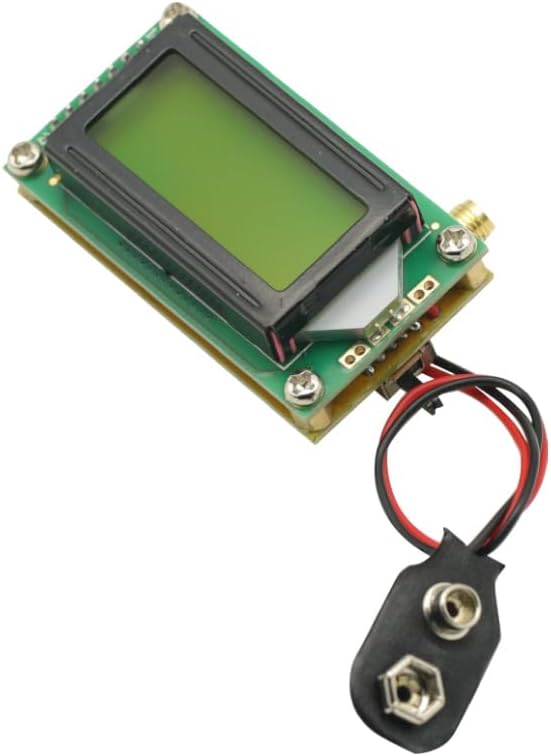
Powered by a standard 9V battery it is easy to keep charged or replace during field days without needing specialized power supplies.
While it lacks the wide range of other models it is an excellent dedicated tool for local repeater and simplex frequency verification.
The single button interface ensures that anyone can use it immediately without reading a manual first.
Ideal for clubs or users who only need to verify common VHF and UHF amateur radio frequencies.
We may earn a commission when you buy through this link, at no additional cost to you.
The Anysecu SF-103 is an upgraded version of the popular SF401 offering a wider frequency range up to 2.8GHz for broader compatibility.
We may earn a commission when you buy through this link, at no additional cost to you.
It retains the signal strength indicator and simple button layout which makes it familiar to users who have used earlier models.
This unit is well suited for maintenance personnel who need to verify frequency and strength across various two-way radio systems efficiently.
If you need to cover more bands than the standard SF401 this model provides a cost-effective solution with increased versatility.
Upgrading to 2.8GHz allows you to measure a broader array of commercial and amateur radio transmissions.
The design is robust enough for technicians who need a reliable tool for daily radio checks.
We may earn a commission when you buy through this link, at no additional cost to you.
This Mcbazel model provides similar performance to the Anysecu SF-103 with a TCXO that ensures stable readings across temperature changes.
We may earn a commission when you buy through this link, at no additional cost to you.
It covers the 2m amateur band and all VHF UHF frequencies making it a versatile tool for most radio enthusiasts.
The battery level warning feature is a practical addition that prevents unexpected shutdowns during critical testing situations.
Overall it is a reliable handheld unit that offers a balance of performance and price for regular use in the field.
The TCXO oscillator maintains accuracy even when outdoor conditions shift which is vital for consistent measurements.
A clear battery indicator ensures you know when to recharge so testing sessions are not interrupted.
We may earn a commission when you buy through this link, at no additional cost to you.
This Acxico frequency counter is designed as a module rather than a standalone handheld which appeals to those building custom test equipment.
We may earn a commission when you buy through this link, at no additional cost to you.
It measures from 1 to 500MHz and features a digital LCD display that is sufficient for hobbyist projects and basic RF verification.
Because it is a PCB module you will need to integrate it into your own device which requires some technical skill to assemble.
It is a budget-friendly option for DIY enthusiasts who want to create their own testing stations without buying expensive pre-built tools.
Build it into your own test rig for a custom solution that fits your specific lab needs.
At a low price point it offers access to frequency counting without the cost of commercial handheld meters.
We may earn a commission when you buy through this link, at no additional cost to you.
Similar to the Acxico module this board offers a basic frequency counting solution suitable for educational purposes and simple kit builds.
We may earn a commission when you buy through this link, at no additional cost to you.
It operates with low power consumption which is beneficial for battery powered projects where efficiency matters.
The kit format allows you to understand how frequency counters work internally providing a learning experience alongside functionality.
While not as precise as commercial handhelds it is a great stepping stone for those new to RF electronics and circuit design.
Assembling the board teaches core electronics concepts while delivering functional frequency measurement capabilities.
Low power draw makes it suitable for portable DIY test rigs where battery life is a priority.
We may earn a commission when you buy through this link, at no additional cost to you.
The AURSINC TinyGTC 7GHz represents the pinnacle of portable frequency counting with a GPS disciplined oscillator that delivers laboratory-grade accuracy anywhere.
We may earn a commission when you buy through this link, at no additional cost to you.
It features dual channel inputs and a resolution of 40 picoseconds allowing for detailed phase and time interval measurements.
The touchscreen and jog wheel interface make navigating complex settings intuitive while the rechargeable battery supports full field use.
This instrument is perfect for serious RF professionals and advanced hobbyists who require uncompromising precision for calibration and testing.
Syncing to GPS ensures your measurements stay accurate over long periods regardless of environmental temperature changes.
Testing two signals simultaneously allows for advanced analysis like phase comparisons and beat frequency calculations.
We may earn a commission when you buy through this link, at no additional cost to you.
Selecting the right frequency counter involves understanding your specific needs and the technical capabilities offered by different models.
Ensure the device covers the bands you use most such as HF VHF or UHF as models vary from limited 136 to 174MHz up to 7GHz.
Choosing a wide range ensures you can measure everything from CB to microwave links without needing multiple tools.
Look for TCXO or GPS disciplined oscillators as they provide stable readings that do not drift significantly with temperature changes.
Higher accuracy is critical for calibration while basic handhelds may suffice for simple walkie talkie verification.
If you use DMR or other digital modes check if the counter supports decoding digital signals or measuring their carrier frequency effectively.
Not all counters can read digital signals so confirm compatibility before purchasing for modern radio systems.
LCD screens offer basic numeric readouts while touchscreens provide visual spectrum views and more intuitive menu navigation.
A clear display with high contrast ensures you can read values easily in bright sunlight during field operations.
For field use consider size weight and battery life as handhelds with rechargeable cells are more convenient than benchtop units.
A rugged portable design allows you to carry the counter in a bag without fear of damage during transport.
Check maximum input voltage limits to avoid damaging the device if you connect it directly to a high power radio output.
Proper attenuation or protection is necessary to ensure longevity when testing powerful transmitters.
USB or SCPI connectivity allows you to log data or control the device from a computer for advanced analysis.
This feature is useful for lab work where automated logging or remote access is required.
A two-year warranty provides peace of mind and ensures you have recourse if the unit fails prematurely.
Always verify customer support availability before buying from lesser known brands to guarantee service access.
Always ensure the device is set to the correct frequency range before transmitting to avoid overload and potential damage to the internal circuitry.
Use attenuators when testing high-power transmitters to protect the counter input from signals that exceed its voltage limits.
Keep the unit clean and dry and store it in a protective case when not in use to prevent dust or moisture from affecting performance.
For beginners the Mcbazel Surecom SF401 Plus is an excellent choice due to its wide frequency range and ease of use. It provides all the necessary features without complex menus or high cost.
Only if you require laboratory-grade accuracy for calibration or precise scientific measurements. For general radio checks a TCXO model is sufficient and more affordable.
Some models like the FC-2800M support DMR signals while others may only read the carrier frequency. Always verify digital capabilities if you use digital modes.
Use external attenuators to reduce the signal strength to a safe level before connecting it to the counter input port.
It depends on the radio power and counter input limit. Always consult the manual to avoid damaging the counter with high voltage signals.
Most portable counters use rechargeable lithium batteries or standard AA and 9V cells depending on the model design.
Drift may be caused by temperature changes or poor signal quality. A TCXO or GPSDO model helps minimize this effect significantly.
Battery life varies by model but most portable units last several hours on a single charge or set of batteries.
We have highlighted ten distinct options ranging from basic handhelds to advanced GPS disciplined units to suit every level of ham radio enthusiast.
Prioritize accuracy and range if you work across multiple bands but consider ease of use if you mainly check handheld transceivers.
Always verify the latest pricing and availability before purchasing to ensure you get the best value for your specific needs.