
1/2" Flow Hall Sensor
4.7Editor score
Affordable 1-30L/min range
Integrated magnetic hall effect sensor
Lightweight easy install design
Finding the right Arduino flow meter is essential for any project requiring precise fluid measurement. These sensors convert water movement into digital pulses that your microcontroller can read easily. Whether you are building a smart irrigation system or monitoring water usage, choosing the correct model ensures reliability and accuracy across different flow rates.
We evaluated ten highly rated flow meters based on their compatibility with Arduino boards, build quality, and ease of integration. Each product was assessed for its ability to handle varying water pressures and its durability over time. Our selection includes options for both small-scale hobbyist projects and larger industrial applications requiring robust performance.
Each pick below highlights specific strengths such as connection type, flow range, and output signal clarity. You will find detailed insights into how these sensors perform in real-world scenarios. Please note that prices and availability can change frequently, so verify current stock before making your final purchase decision for your next build.
4.7Editor score

5.0Editor score

5.0Editor score
As an Amazon Associate we earn from qualifying purchases.
The following table provides a side-by-side comparison of all ten selected flow meters. It highlights key specifications like flow range, voltage requirements, and connection types to help you quickly identify the best fit for your specific Arduino project needs.


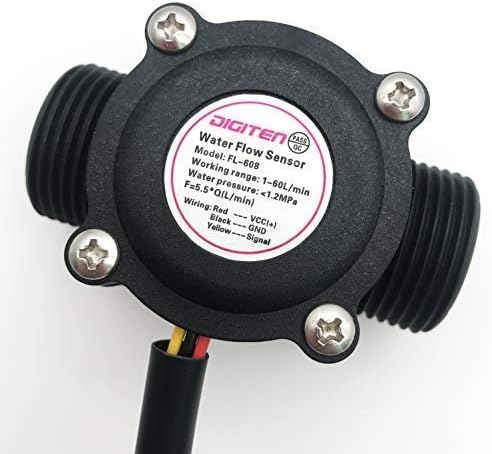
The DIGITEN G1.5 water flow sensor stands out as the top choice for serious projects requiring high volume measurement. With a perfect rating from users, it delivers exceptional reliability in both home and industrial applications. Its robust construction ensures it withstands varying pressures without compromising signal integrity.
We may earn a commission when you buy through this link, at no additional cost to you.
This model supports a wide flow range from 5 to 150 liters per minute, making it ideal for large-scale irrigation or water treatment systems. The G1.5 inch BSPT male thread connects easily to standard piping, while the hall effect sensor provides consistent square wave outputs. Materials conform to ROHS standards ensuring safety for drinking water applications.
One trade-off is that this sensor is designed for larger pipes which may not suit small hobby projects. Additionally the higher price point reflects its premium build but might be overkill for simple experiments. However the long-term durability and precision justify the investment for critical monitoring tasks.
Engineers and advanced hobbyists working with substantial water flow should prioritize this model. Its compatibility with Arduino and Raspberry Pi allows seamless integration into complex automation networks. For projects demanding high volume throughput and long-term stability this sensor offers unmatched performance in its class.
The 5-150L/min range supports demanding industrial and agricultural tasks efficiently.
ROHS compliant materials ensure the sensor is safe for potable water systems.
We may earn a commission when you buy through this link, at no additional cost to you.
This 1/2 inch flow hall sensor offers an affordable entry point for anyone needing basic water flow monitoring. Rated highly for value it provides reliable pulse counting for standard domestic applications. Its compact size makes it easy to fit into tight spaces where larger sensors cannot go.
We may earn a commission when you buy through this link, at no additional cost to you.
The integrated magnetic hall effect sensor ensures safe operation by staying dry outside the water pipe. It supports a flow range of 1 to 30 liters per minute which covers most household needs like coffee machines and water purifiers. The lightweight design simplifies handling during installation and maintenance tasks.
While it lacks the high-end build of premium models it performs well for general purpose tasks. The signal output depends on correct flow direction which can be a minor setup hurdle. However the price and ease of use make it a practical choice for hobbyists on a budget.
Beginners and cost-conscious users will find this sensor ideal for learning fluid dynamics. It pairs well with Arduino boards for simple counting and display projects. If you need reliable performance without breaking the bank this model delivers consistent results for small to medium flow applications.
Ideal for hobbyists needing reliable monitoring without high expense.
Plug and play design reduces wiring complexity for quick setup.
We may earn a commission when you buy through this link, at no additional cost to you.
The Taidacent YF-S201 Hall effect sensor is a premium choice known for its perfect user rating and industrial grade performance. It is widely used in water heaters and dispensers where precision flow detection is critical. The hall effect technology ensures accurate measurement even with turbulent water flow conditions.
We may earn a commission when you buy through this link, at no additional cost to you.
Designed with a G1/2 interface it connects robustly to standard piping systems. The magnetic rotor rotates at speeds proportional to flow rate allowing the controller to regulate water usage effectively. This makes it suitable for applications needing active control rather than just passive monitoring.
A trade-off is the specific installation orientation required for accurate readings. Users must ensure the flow direction matches the sensor markings to avoid signal errors. Despite this complexity the reliability and build quality justify the effort for professional grade installations.
Professionals and advanced hobbyists seeking maximum reliability should choose this model. It offers the stability needed for commercial equipment and complex home automation systems. For projects where consistent performance under varying loads is essential this sensor provides the foundation you need.
Designed for high-demand environments like commercial water heaters.
Enables active regulation based on real-time flow data.
We may earn a commission when you buy through this link, at no additional cost to you.
DEVMO 1/2 water flow hall sensor provides clear signal thresholds ideal for systems needing distinct on-off switching. With a high amplitude of 4.6 volts it ensures robust signal detection even in noisy environments. This reliability makes it a strong candidate for control switch applications.
We may earn a commission when you buy through this link, at no additional cost to you.
It handles flow rates between 1 and 30 liters per minute efficiently while supporting diverse uses from water testing to vending machines. The electric strength of 1250V adds durability against electrical surges which protects connected electronics. This extra layer of safety is valuable in commercial settings.
Users should verify voltage compatibility to ensure the output matches their microcontroller inputs. While robust the plastic body is standard for this class and may wear if exposed to harsh chemicals. Overall the signal clarity and protective features make it a solid intermediate choice.
Developers building custom control systems will appreciate the distinct signal levels. It simplifies coding logic by reducing noise interference in pulse counting. For projects needing a reliable switch rather than just a meter this sensor offers the necessary precision and protection.
High voltage output ensures distinct readings for accurate switching logic.
High electric strength protects circuits from unexpected voltage surges.
We may earn a commission when you buy through this link, at no additional cost to you.
This 1/2 inch food grade sensor is explicitly designed for safe use with drinking water systems. The plastic materials conform to ROHS standards ensuring no harmful substances leach into the water. This focus on hygiene makes it perfect for water purifiers and beverage machines.
We may earn a commission when you buy through this link, at no additional cost to you.
Operating between 5 and 24 volts it offers flexibility with various power supplies and microcontrollers. The flow range covers typical household needs allowing precise measurement for usage tracking. Installation is straightforward with standard BSPT threads ensuring a secure fit in most setups.
The average rating suggests occasional variability in build consistency compared to premium brands. Users may find the signal output slightly less precise under turbulent flow conditions. However for basic monitoring tasks the safety standards and price balance are appealing.
Homeowners and food service equipment builders should consider this model for safety compliance. It provides a reliable way to measure water usage without compromising health standards. If drinking water safety is your priority this sensor delivers essential compliance at a reasonable cost.
Food grade and ROHS compliant materials protect water quality integrity.
Broad voltage range allows connection to diverse power sources easily.
We may earn a commission when you buy through this link, at no additional cost to you.
The YF-S201C transparent flow sensor allows you to visually inspect the rotor condition during operation. This unique feature helps identify debris or wear quickly without disassembly. The transparent valve body makes it an excellent tool for educational demonstrations and system diagnostics.
We may earn a commission when you buy through this link, at no additional cost to you.
It supports a broad voltage range from 3.5 to 24 volts ensuring compatibility with many battery systems. Internal stainless steel beads increase wear resistance extending the sensor life in continuous flow conditions. The dual pack offers value for setups requiring multiple monitoring points.
However the transparent body might be more prone to scratching or clouding over time. This can obscure visual inspection in dirty water environments. The lower user rating reflects these potential durability issues compared to opaque models.
Educators and hobbyists who benefit from visual feedback will enjoy this model. It simplifies troubleshooting by showing internal components directly. If seeing the internal mechanics is important for your project this sensor provides a distinct functional advantage.
See rotor rotation to confirm operation or identify blockages.
Two sensors included allow for comprehensive system monitoring.
We may earn a commission when you buy through this link, at no additional cost to you.
This 1/4 inch sensor excels at measuring low flow rates that larger meters miss. Designed for hosepipe connections it fits seamlessly into drip irrigation or small dispenser setups. The food grade material ensures safety even for direct drinking water applications.
We may earn a commission when you buy through this link, at no additional cost to you.
The flow range of 0.5 to 3 liters per minute is perfect for slow dispensing or micro irrigation. It provides precise readings for low volume usage where standard sensors fail. The compact size ensures it does not obstruct narrow pipes or tubing.
Installation requires matching the hose inner diameter precisely for a leak free seal. Users should apply thread tape if converting to rigid piping to avoid issues. The lower flow limit means it is not suitable for high volume systems but works well for precision.
Gardeners and small-scale brewers will find this sensor ideal for water conservation projects. It helps track minor leaks or precise dispensing amounts accurately. For applications where every drop counts this model offers specialized low flow detection capabilities.
Accurately measures small volumes missed by larger industrial sensors.
Fits easily into tight spaces and narrow tubing without blockage.
We may earn a commission when you buy through this link, at no additional cost to you.
This DIGITEN model simplifies wiring by including a 1.2 meter cable with an SM2.54 connector. It eliminates the need for extra soldering or extension wires during installation. The pre-wired design makes it much easier to install in tight spaces.
We may earn a commission when you buy through this link, at no additional cost to you.
The G1/2 BSPT thread supports standard pipe sizes while the cable reaches further than direct mount models. This flexibility is useful when the Arduino board is distant from the water pipe. It ensures stable signal transmission without added complexity.
One consideration is the fixed cable length which cannot be extended without extra adapters. Users must plan the distance carefully before purchase to avoid issues. However the quality of the cable and connector ensures reliable data transfer.
DIYers and system integrators will appreciate the simplified connection process. It reduces setup time and potential wiring errors significantly. For projects needing distance between sensor and controller this cable solution saves time and effort.
Pre-attached cable and connector remove the need for soldering.
1.2 meter cable allows sensor placement away from the controller.
We may earn a commission when you buy through this link, at no additional cost to you.
The DIGITEN G3/8 sensor balances compact size with a medium flow range suitable for many applications. Its G3/8 inch connection fits smaller pipes found in beverage machines and small dispensers. This allows precise monitoring without bulky hardware.
We may earn a commission when you buy through this link, at no additional cost to you.
Operating voltage ranges from 3.5 to 12 volts which works well with battery powered projects. The hall effect sensor provides a clean square wave output for reliable pulse counting. Users report good durability in daily use thanks to the water resistant build.
The specific thread size may require adapters if your plumbing uses standard 1/2 inch. Users should measure pipe dimensions before purchase to ensure compatibility. While the flow range is narrower than larger models it covers typical household needs efficiently.
Homebrewers and small cafe owners will find this model perfect for their needs. It supports precise dosing and flow tracking with compact dimensions. If your pipes match the thread size this sensor offers reliable performance and easy integration.
Fits in tight spots without requiring bulky adapters.
Balances precision and capacity for typical commercial use.
We may earn a commission when you buy through this link, at no additional cost to you.
The DIGITEN G3/4 sensor with cable offers high flow capacity for large residential or commercial systems. The 1.2 meter cable allows flexible placement away from the water pipe connection. This combination supports significant water movement up to 60 liters per minute.
We may earn a commission when you buy through this link, at no additional cost to you.
Its G3/4 inch BSPT thread connects directly to large pipes without adapters. The cable simplifies wiring for remote monitoring setups. It meets ROHS standards ensuring safety for potable water applications in various environments.
The lower user rating suggests potential issues with build quality or calibration. Users have reported occasional signal drops in turbulent flow conditions. Proper installation and flow direction must be followed to maximize performance.
Large scale irrigation users or water treatment operators might need this capacity. It allows monitoring high volumes where smaller sensors would fail. If your plumbing requires larger threads this model provides a convenient pre-wired solution.
Designed for larger systems needing significant flow monitoring.
Integrated cable reduces wiring complexity for remote setups.
We may earn a commission when you buy through this link, at no additional cost to you.
Selecting the right Arduino flow meter requires evaluating several technical factors. This guide explains the key considerations to ensure your sensor matches your project requirements perfectly.
Every project has a specific flow rate demand that the sensor must accommodate. For small household tasks like coffee machines a range of 1 to 30 liters per minute is usually sufficient. However industrial applications may require models capable of handling over 100 liters per minute to remain accurate. Choosing a sensor outside this range can lead to unreliable readings or mechanical wear over time.
Always calculate your expected maximum flow rate before selecting a model.
Physical installation depends heavily on the thread size and standard of your plumbing. Common types include NPT BSPT and metric threads which are not interchangeable. A mismatch can cause leaks or require additional adapters that increase cost and complexity. Verify your pipe diameter and thread pitch to ensure a direct fit where possible.
Match the sensor thread to your existing pipes to avoid installation issues.
Arduino boards typically operate at 5 volts logic levels which must match the sensor output. Most hall effect sensors provide a square wave pulse that counts revolutions for flow calculation. Ensure the voltage range supports your power source whether battery or mains supply. Signal clarity is critical for accurate counting so avoid models with noisy outputs.
Confirm the output voltage matches your microcontroller input specs.
If you are measuring drinking water or food fluids the materials must be non-toxic. Look for certifications like ROHS or food grade plastic to ensure safety. Cheaper models might use materials that degrade or leach harmful substances. This factor is critical for health-related projects and commercial compliance.
Prioritize food grade materials for any potable water application.
The distance between the sensor and your controller dictates whether you need an extended cable. Some models include pre-wired cables while others require you to solder wires directly. Longer cables can introduce signal noise if not shielded properly. Plan your layout to minimize wiring complexity and potential interference.
Decide if you need a pre-wired model based on your setup distance.
The environment where the sensor operates affects its lifespan significantly. Water pressure resistance is essential to prevent leaks under high flow conditions. Heat and cold resistance also matter if used in outdoor or extreme environments. Robust build quality ensures the sensor lasts longer without maintenance.
Choose a model rated for your specific operating pressure and temperature.
Many flow sensors are unidirectional meaning they only work when water flows one way. Installing them backwards will result in no signal or negative readings. Always check the flow direction arrow on the housing before mounting. This is a common setup error that can be easily avoided.
Follow the flow direction arrow on the sensor housing carefully.
Cost varies based on build quality and specific features like cable length. Basic hobby models are affordable while industrial grade sensors cost more. Determine your budget and prioritize features that matter most to your project. A mid-range model often offers the best balance of performance and value.
Balance features and cost to fit your project budget realistically.
First ensure your sensor is installed at a location with stable flow. Sudden pressure spikes can cause inaccurate readings or damage the internal rotor. Use appropriate seals and thread tape to prevent leaks around the connection points.
Second write code that counts interrupts or pulses from the hall effect sensor accurately. Use a timer to convert pulses per second into liters per minute. This calibration ensures your data is meaningful and useful for your application.
Third maintain your sensor by checking the rotor for debris periodically. If you are using transparent models inspect them for clouding or cracks. Regular maintenance extends the lifespan of the sensor and keeps your data reliable over time.
Yes but you must ensure the sensor is made of food grade plastic and complies with ROHS standards. Non-toxic materials are critical to prevent contamination in your drinking water system. Always check the product specifications for safety certifications before installation.
NPT and BSPT are thread standards that are not compatible without an adapter. NPT is common in North America while BSPT is used in other regions. Check your existing plumbing to choose the correct sensor thread.
Calibration usually involves measuring known volumes of water and adjusting your code accordingly. Compare the sensor output with a manual measurement to find the conversion factor. This ensures your calculated flow rate matches reality.
Most models require DC 5 to 24 volts. Ensure your power supply matches this range. Connecting too low a voltage may prevent the sensor from turning on while too high could damage the electronics.
Most hall effect sensors are designed for clean water. Viscous liquids or debris-filled fluids may damage the rotor. If measuring other liquids check the manufacturer guidelines to avoid damage or inaccurate readings.
Installation is generally straightforward if you match the thread size to your plumbing. Ensure the flow direction arrow points correctly with the water flow. With basic tools most hobbyists can install these sensors within minutes.
We reviewed ten Arduino flow meters ranging from budget-friendly options to premium industrial models. The DIGITEN G1.5 offered the best overall performance while the 1/2 inch hall sensor provided excellent value for beginners. The Taidacent YF-S201 remained a top choice for high reliability needs.
When choosing prioritize flow range and thread compatibility to ensure your project runs smoothly. Material safety and voltage requirements are also critical factors for long-term success. Matching these details to your specific needs will prevent installation headaches later.
Always check current availability and pricing before purchasing as these factors change frequently. Verify the specifications on the product page to ensure they match your requirements. With the right sensor your Arduino project will achieve precise and reliable water monitoring.