We compare the top external sound cards for guitar including interfaces and adapters to help you find the right gear for recording and live performance today.
As an Amazon Associate we earn from qualifying purchases. We may earn a commission when you buy through links on this page, at no additional cost to you. Read our affiliate disclosure.As an Amazon Associate we earn from qualifying purchases.Purchases through our links may earn us a commission, at no extra cost to you. Read our affiliate disclosure.
Finding the right external sound card for guitar is essential for musicians who want to capture their tone accurately. These devices convert analog signals from your instrument into digital data that your computer can process for recording or streaming purposes.
To create this list, we evaluated ten different models ranging from dedicated audio interfaces to simple USB adapters. We considered factors like input types, sampling rates, latency, and software bundles to ensure they meet diverse musician needs.
Each pick below highlights specific strengths such as portability, preamp quality, or included software. Remember that product availability and pricing can change frequently so always check the current details before making your final purchase decision.
Top 3 Picks for Best External Sound Cards for Guitar
Best Budget
Fender Quantum HD 2 | 20×24 USB-C Audio Interface for Music Production, MAX-HD Mic Preamps, Front Instrument Inputs, ADAT & S/PDIF I/O, Auto Gain, Re-Amp Outputs, Loopback, Headphone Amp, Mac & PC
Top 10 Best External Sound Cards for Guitar in 2026 Compared
This table provides a side-by-side comparison of all ten selected products to help you quickly identify the model that fits your specific recording requirements and budget constraints.
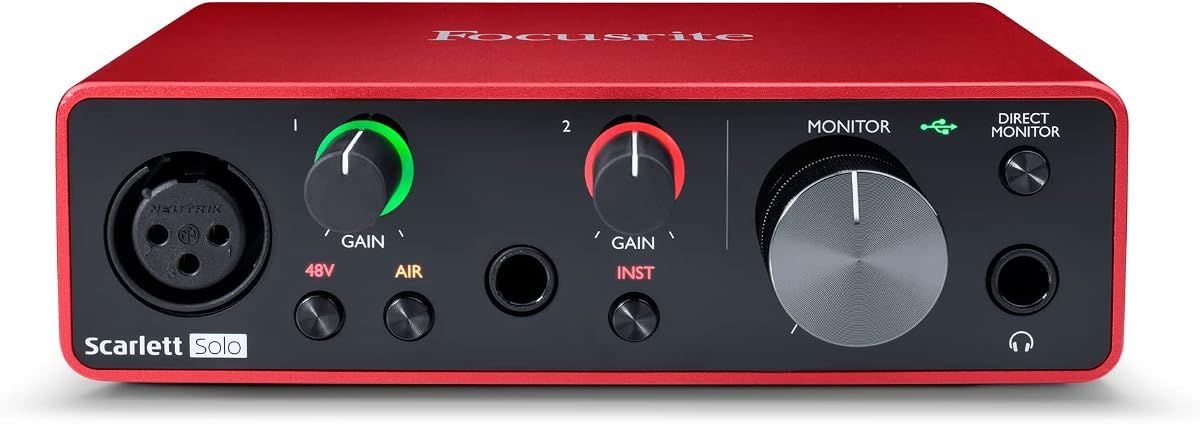
Focusrite Scarlett Solo 3rd Gen USB-C Audio Interface
24-bit/192kHz resolution
High-headroom instrument inputs
Gain Halos technology
Pro Tools Intro included
The Focusrite Scarlett Solo 3rd Gen stands out as a top choice for guitarists needing reliable audio conversion. It earns high praise for its high-performance mic preamps and ability to capture detailed recordings.
Pros
Crystal clear preamps
Gain Halos prevent clipping
Wide software bundle
Durable build quality
High-resolution recording
Cons
Only two inputs
No direct monitoring dial
We may earn a commission when you buy through this link, at no additional cost to you.
Its high-headroom instrument inputs ensure your guitar tone remains clean even at high volumes. The Gain Halos feature helps you set levels quickly without worrying about distortion during takes.
While it offers robust performance, it does not include a physical monitor mix dial which some users might prefer for latency-free listening. The software bundle is extensive but requires setup time.
This interface is ideal for solo musicians or home studio owners seeking professional sound. It balances ease of use with high-quality audio conversion for a wide range of projects.
High Performance Preamps
Achieve a brighter recording thanks to the high performing mic pre-amps of the Scarlett 3rd Gen.
Gain Control Tools
Capture your voice and instruments without any unwanted clipping or distortion thanks to our Gain Halos.
Fender Quantum HD 2 | 20×24 USB-C Audio Interface for Music Production, MAX-HD Mic Preamps, Front Instrument Inputs, ADAT & S/PDIF I/O, Auto Gain, Re-Amp Outputs, Loopback, Headphone Amp, Mac & PC
20×24 USB-C interface
MAX-HD mic preamps
Auto Gain button
ADAT and S/PDIF I/O
The Fender Quantum HD 2 offers ultra-high-fidelity capture with MAX-HD mic preamps designed for pristine instrument recording. It is built for serious production needs with extensive I/O options.
Pros
Ultra-high-fidelity capture
Fender amp models included
Dual re-amp outputs
32-bit/192 kHz converters
Loopback routing
Cons
Higher price point
Requires app registration
We may earn a commission when you buy through this link, at no additional cost to you.
It unlocks the Complete Fender Amp & FX Pack through the Fender Studio app providing authentic tones for guitar work. The Auto Gain button sets perfect levels instantly which speeds up sessions.
The dual re-amp outputs allow you to explore new tones with external gear easily. However the higher price and need for app registration might be barriers for some users.
This interface is perfect for professional studios or advanced users wanting top-tier gear. It delivers professional clarity and flexibility for complex hybrid studio setups.
Fender Studio Integration
Unlock the Complete Fender Amp & FX Pack in the Fender Studio app to access a full collection of authentic Fender amp models.
High Performance Converters
High-performance 32-bit/192 kHz converters ensure professional clarity for studios creators and musicians.
MAONO PS22 Lite USB Audio Interface for PC for Guitar & Vocals Streaming
24-bit/192kHz recording
106dB dynamic range
ProStudio Routing Software
Plug-and-play capability
The MAONO PS22 Lite delivers high-resolution recording at 24-bit/192kHz ensuring clear and realistic sound. It is designed for recording enthusiasts and streamers needing versatile connectivity.
Pros
High-resolution 192kHz recording
Includes ProStudio Routing Software
Direct monitoring switch
Compact and lightweight
Low latency output
Cons
Software can be complex
Build feels plasticky
We may earn a commission when you buy through this link, at no additional cost to you.
Its dynamic range of 106dB ensures details are captured accurately. The ProStudio Routing Software opens up possibilities for live streams with virtual channels and loopbacks.
While it offers great value the software setup might be complex for absolute beginners. The plastic build is light but less durable than metal alternatives.
This interface is an excellent entry point for those starting content creation. It balances professional features with an accessible price for beginners.
Detailed Sound Capture
With high-resolution recording at 24-bit/192kHz and a dynamic range of 106dB this USB audio interface ensures your sound is as clear as original.
Streaming Software Included
The ProStudio Routing Software included with this computer recording audio interface opens up a world of possibilities with additional virtual channels.
The M-AUDIO M-Track Duo delivers 48kHz audio resolution for pristine recording every time. It covers podcasting recording and live streaming with versatile inputs.
Pros
Crystal Preamps for clarity
USB/Direct switch for monitoring
Includes MPC Beats software
Phantom power available
Stereo outputs
Cons
Fixed 48kHz rate
Limited to two inputs
We may earn a commission when you buy through this link, at no additional cost to you.
Its transparent Crystal Preamps guarantee optimal sound from all microphones including condenser mics. The USB/Direct switch allows zero latency monitoring for accurate tracking.
The included MPC Beats software adds value for producers needing production tools. However the fixed 48kHz rate limits high-resolution work compared to other models.
This interface is suitable for podcasters and musicians needing reliable tools. It offers fuss-free monitoring and quality preamps for various recording needs.
Crystal Preamps
M-Track Duo’s transparent Crystal Preamps guarantee optimal sound from all your microphones including condenser mics.
Fuss-Free Monitoring
Everything you Demand from an Audio Interface for Fuss-Free Monitoring with 1/4 headphone output and stereo 1/4 outputs.
Fender AudioBox GO USB Audio Interface, for Guitarist, Vocalist, or Producer. Includes easy to use software, Fender Studio app, Amp and FX pack to create Studio Quality recordings. PC/Mac
2×2 USB-C interface
24-bit/96kHz converters
Dedicated TS input
Bus-powered design
The Fender AudioBox GO is an ultra-compact 2×2 USB-C interface ideal for mobile recording. It unlocks the Complete Fender Amp & FX Pack for authentic tones.
Pros
Ultra-compact design
Dedicated TS instrument input
Fender Amp & FX Pack
Bus-powered for mobility
Zero-latency monitoring
Cons
Limited inputs
No line-in XLR
We may earn a commission when you buy through this link, at no additional cost to you.
It features a dedicated TS instrument input optimized for guitar and bass recording. Zero-latency headphone monitoring with mix control ensures real-time tracking accuracy.
The bus-powered design makes it effortless to use on the go without external power. It lacks some inputs found on larger interfaces which limits expansion.
This interface is perfect for guitarists wanting studio quality on a budget. It balances portability with essential features for mobile musicians.
Fender Amp Tones
Unlock the Complete Fender Amp & FX Pack in the Fender Studio app to access authentic amp models and effects.
Zero-Latency Monitoring
Zero-latency headphone monitoring with mix control for real-time tracking ensures accurate performance.
Sound Blaster Play! 3, USB Audio Adapter, 24-bit 96kHz Plug & Play
24-bit 96kHz
No drivers needed
Easy headphone connectivity
Downloadable software included
The Sound Blaster Play! 3 is a simple USB audio adapter for basic audio needs. It works straight out of the box without needing extra drivers.
Pros
No drivers needed
24-bit 96kHz resolution
Powerful software control
Easy headphone setup
Plug and Play
Cons
No instrument input
Not designed for music
We may earn a commission when you buy through this link, at no additional cost to you.
It supports 24-bit 96kHz resolution and includes downloadable software with powerful audio enhancements. Headphone connectivity is easy even for split connectors.
This adapter is not designed for music production as it lacks an instrument input. It is better for listening and basic playback tasks.
This adapter is best for users needing a quick audio boost. It offers reliable performance for everyday tasks without extra setup.
No Drivers Required
No drivers needed works straight out of the box for simple plug and play operation.
Audio Enhancements
Powerful downloadable software control panel software gives powerful Audio Enhancements and unprecedented control.
StarTech 7.1 USB Audio Adapter, External Sound Card (ICUSBAUDIO7D)
7.1 channels output
44.1KHz sampling rate
SPDIF optical input
Volume controls included
The StarTech 7.1 USB Audio Adapter adds up to 7.1 channels of audio through a single USB port. It upgrades existing integrated audio on desktops or laptops.
Pros
Adds 7.1 channels
Supports digital audio output
Volume controls included
Easy installation
Bus-powered
Cons
Fixed sampling rate
Not for instruments
We may earn a commission when you buy through this link, at no additional cost to you.
It supports analog and digital audio output for various channel configurations. Volume controls and mute buttons are included for easy adjustment.
The fixed 44.1KHz sampling rate limits high-resolution needs. This device is better for multimedia playback than professional recording work.
This adapter is suitable for users wanting surround sound support. It offers easy installation and reliable audio output upgrades.
7.1 Channels
This External Sound Card adds up to 7.1 channels of audio through a single USB port to your computer.
Digital Output
Supports 44.1KHz and 48KHz sampling rates for analog playback and recording with SPDIF Digital output.
Synido A10 Portable USB-C Audio Interface for Guitar & DJ Recording
24-bit/48kHz resolution
Zero-latency monitoring
Wireless backing tracks
Aluminum alloy body
The Synido A10 delivers pristine 24-bit/48kHz resolution capturing every nuance of your performance. Its advanced dual-core chip ensures zero-latency monitoring.
Pros
Wireless backing tracks
Zero-latency monitoring
Aluminum alloy build
Portable design
Record while charging
Cons
Limited software support
No XLR input
We may earn a commission when you buy through this link, at no additional cost to you.
It features exclusive wireless accompaniment playback allowing you to stream backing tracks without cables. The aluminum alloy body is both portable and durable.
Limited software support and lack of XLR input restrict advanced recording needs. However it is great for mobile guitar sessions.
This interface is perfect for musicians needing portability and quality. It balances professional monitoring with ease of use on the go.
Wireless Integration
Elevate your creativity with exclusive wireless accompaniment playback to stream backing tracks directly from one phone to the recording phone.
Zero-Latency Monitoring
The dedicated one-switch monitor function allows real-zero-latency listening so you can play and record with confidence.
Cubilux CB5 USB Audio Interface for Recording, Streaming, Podcasting, USB to 3.5mm Sound Card with Stereo Microphone Input, Line-In, Line-Out & Headphone Jack for Monitors, Support Windows & Mac OS
5-In-1 Audio Hub
96 KHz/24-bit
Hi-Res DAC
Portable design
The Cubilux CB5 converts USB ports into multiple jacks for various devices. It captures crisp sound with decent clarity up to 96 KHz/24-bit.
Pros
5-In-1 Audio Hub
Studio Recording Quality
Ultra-Low Noise
Portable design
Multi-Track Recording
Cons
Limited input types
Output restrictions
We may earn a commission when you buy through this link, at no additional cost to you.
Its 5-In-1 Audio Hub lets you connect microphones instruments and headphones conveniently. Multi-Track Recording is possible by assigning independent device names.
Output restrictions mean line-out and audio output cannot be used simultaneously. This limits flexibility compared to dedicated interfaces.
This interface is suitable for podcasters needing connectivity. It balances clarity with a compact design for on-the-go use.
Audio Hub Connectivity
Cubilux CB5 USB Audio Interface converts the USB port of your laptop into 2 stereo microphone jacks and 1 line-in jack.
Hi-Res DAC
The Built-in advanced chip enables Cubilux CB5 to capture crisp and precise sound with decent clarity up to 96 KHz/24-bit.
Cubilux 7.1 USB Surround Sound Card- 48KHz-384KHz Sample Rate for Headphones, Full Aluminum Alloy USB A External Sound Card for Laptop PC-Supports Line-in & Stereo Mic in
7.1 Surround Sound
384KHz sample rate
Full Aluminum Alloy Case
Plug & Play
The Cubilux 7.1 USB Surround Sound Card offers a rich audio experience with 7.1 and 5.1 surround sound. It supports Hi-Res music with sample rates up to 384KHz.
Pros
7.1 Surround Sound
384KHz sample rate support
Aluminum Alloy Case
Plug and Play
Compact Design
Cons
Not for live recording
Windows restrictions
We may earn a commission when you buy through this link, at no additional cost to you.
Its full aluminum alloy housing ensures isolation of electronic interference without static or ground noise. It works seamlessly with PCs and MacBooks lacking 7.1 cards.
It is not optimized for live recording or instruments. The product does not support Windows XP and older versions limiting some users.
This card is best for immersive music listening and gaming. It offers durable construction and high-resolution playback for headphones.
Surround Audio
Immerse yourself in a rich audio experience with 7.1 and 5.1 USB surround sound perfect for gaming movies and music.
Hi-Res Support
The headphones output supports sampling rates and resolution from 44.1Khz/16-bit to 384Khz/24-bit.
We may earn a commission when you buy through this link, at no additional cost to you.
Buying Guide – How to Choose the Best External Sound Card for Guitar
Selecting the right audio interface requires understanding key technical factors that impact your sound quality and workflow efficiency.
Input Types
Check for dedicated instrument inputs like TS or TRS jacks to connect your guitar directly without signal loss. XLR inputs are useful if you also plan to record vocals simultaneously.
Sample Rate and Bit Depth
Higher sample rates like 96kHz and bit depths like 24-bit capture more audio detail and provide better dynamic range for mixing. Look for interfaces supporting at least 48kHz for standard recording.
Latency and Monitoring
Zero-latency monitoring allows you to hear your guitar signal in real-time without delay. Direct monitoring switches on the device help avoid software delay during tracking.
Software Bundles
Many interfaces include DAW software or amp modeling plugins that add value to the purchase. Check compatibility with your existing workflow and operating system before buying.
Portability
Bus-powered designs allow you to run the interface from your computer without needing extra power adapters. Compact builds are easier to transport for mobile recording setups.
Build Quality
Aluminum alloy casings provide better shielding against interference and durability for frequent travel. Plastic units may be lighter but are often more prone to damage.
Connectivity Options
USB-C connections offer faster data transfer and better compatibility with modern devices. Ensure the cables included match your computer's ports to avoid extra purchases.
Expandability
Interfaces with ADAT or S/PDIF inputs allow you to add more channels later if your recording needs grow. Consider future needs when choosing your initial setup.
How to Use and Care for Your External Sound Card
Connect your guitar directly to the dedicated instrument input using a high-quality cable to preserve signal integrity and minimize interference.
Frequently Asked Questions
Do external sound cards improve guitar tone?
External sound cards provide clean signal conversion that preserves the natural tone of your instrument. They prevent noise and interference that computer sound cards often introduce.
What is the difference between an interface and adapter?
An audio interface offers dedicated instrument inputs and high-quality preamps. An adapter often only provides basic audio output without optimized inputs for recording.
Do I need drivers for my audio interface?
Some interfaces are plug-and-play while others require specific drivers for full functionality. Check manufacturer requirements to ensure compatibility with your system.
Can I use a sound card with mobile devices?
Many USB-C interfaces work with tablets and phones but you may need appropriate adapters. Bus-powered designs are best for mobile use without extra power.
What sample rate should I choose for guitar?
For most guitar recording tasks 48kHz is sufficient. Higher rates like 96kHz may offer slight benefits for heavy editing but require more processing power.
Are external sound cards compatible with Mac?
Most modern interfaces support both Windows and Mac operating systems. Verify specific driver requirements to ensure smooth operation with your software.
Final Thoughts on Choosing the Best External Sound Card for Guitar
The Focusrite Scarlett Solo leads our list for its balance of quality and ease of use across various recording scenarios.
Prioritize input quality and monitoring features if you need professional results or plan to record live performances regularly.
Always verify current availability and specs on product pages as models and details may change over time.
This guide compares the top Bluetooth speakers for bike handlebars based on sound quality, durability, waterproof ratings, and mounting stability for safe