
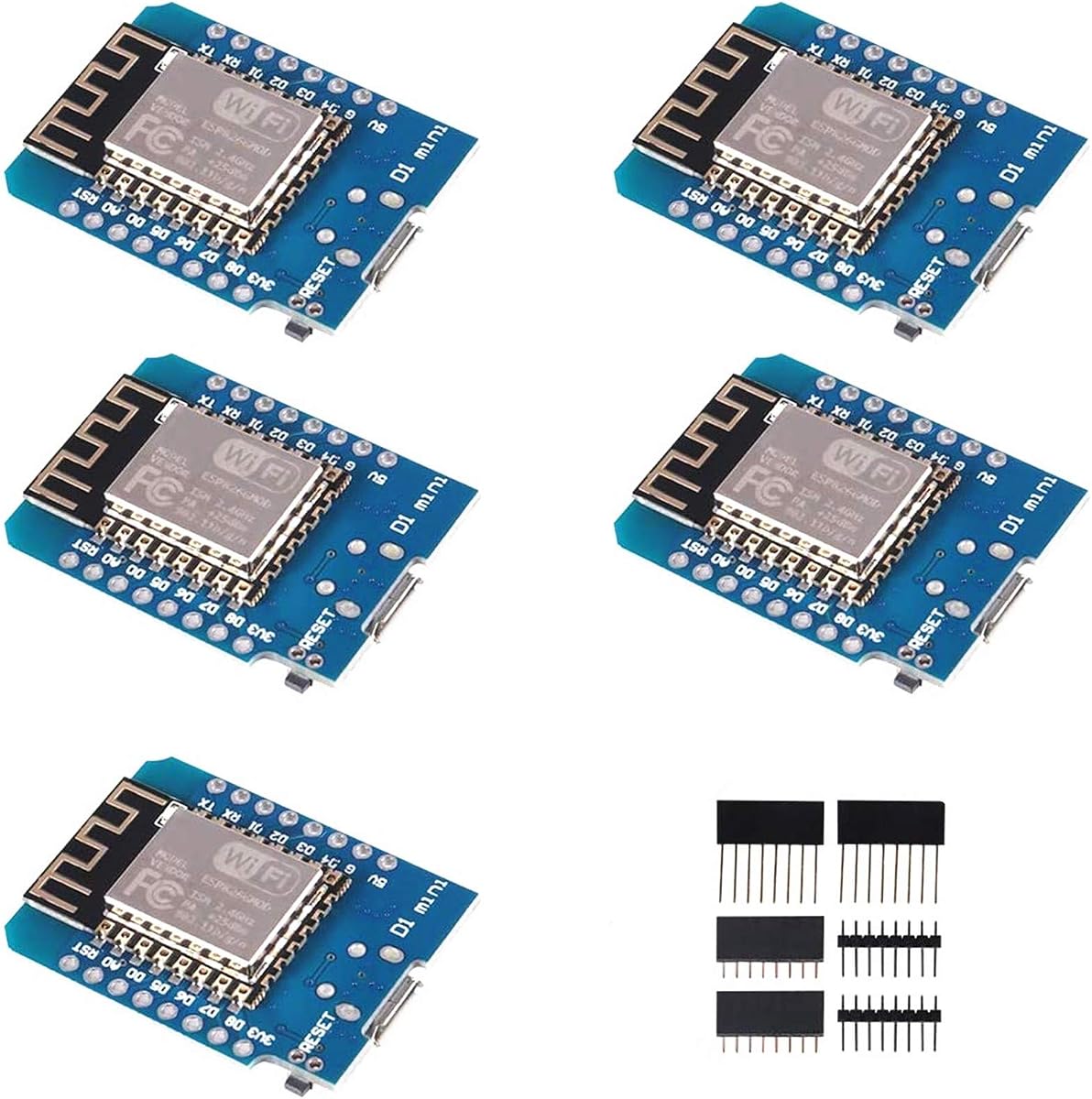
HiLetgo 3pcs ESP8266
4.2Editor score
Affordable three-pack pricing
Compact module design
Compatible with Arduino IDE
This guide compares the top Arduino WiFi Modules for 2026, evaluating connectivity, performance, and features to help you choose the best board for your IoT
Finding the right Arduino WiFi Module is crucial for modern IoT projects. You need reliable connectivity, strong signal strength, and easy integration with your existing development workflow. The right board can transform a simple prototype into a robust smart device.
We evaluated ten top-rated modules based on processor power, wireless capabilities, and community support. Each product was analyzed for its ability to handle complex tasks while maintaining stable network connections. Our goal is to simplify your selection process with accurate data.
Every pick highlights specific strengths for different project needs. Some excel in budget constraints while others offer premium features like dual-core processing. Remember that availability and pricing fluctuate often, so verify current stock before ordering your next component.
4.2Editor score

4.7Editor score

4.7Editor score
This side-by-side comparison highlights the core specifications of each module to help you visualize differences in processing power, connectivity options, and physical form factors for your specific application needs.



The Arduino UNO R4 WiFi stands out as the top choice for advanced IoT projects. Its rating reflects strong community support and robust hardware capabilities. This board merges the reliability of the Renesas RA4M1 with the wireless power of the ESP32-S3.
We may earn a commission when you buy through this link, at no additional cost to you.
Its dual-core processing allows for complex tasks like edge AI and real-time data handling. The integrated LED matrix provides immediate visual feedback without external components. The 12-bit DAC ensures precise analog signal generation for sensitive projects.
While the price is higher than basic modules, the included features justify the cost. You save on peripherals like displays and DACs. This makes it a cost-effective choice for prototyping complex systems quickly.
Ideal for engineers and hobbyists needing premium features in one board. It excels in smart devices requiring high connectivity and processing power. We recommend this for any project demanding reliability and advanced connectivity.
The combination of RA4M1 and ESP32-S3 ensures seamless processing and connectivity. You can handle logic and wireless tasks simultaneously without bottlenecks.
The 12×8 LED Matrix allows status indicators and simple displays on the board itself. This reduces wiring needs for visual output in prototypes.
We may earn a commission when you buy through this link, at no additional cost to you.
This three-pack offers an excellent entry point for beginners exploring wireless projects. The rating indicates reliable performance for basic connectivity needs. Each module uses the classic ESP8266 chip known for wide community support.
We may earn a commission when you buy through this link, at no additional cost to you.
It supports AP STA and mixed modes providing flexibility for network configurations. The compact design fits easily into small enclosures. While simple it handles standard IoT tasks like sensor data logging effectively.
The main trade-off is the lack of integrated USB support. You will need external circuitry for uploading code. This adds a layer of complexity for novices.
Best for developers who need multiple units for testing. It is perfect for large scale sensor networks where cost per unit matters. Choose this if you have the wiring skills to manage external programmers.
Supporting AP STA and combined modes allows versatile networking. You can host local access points or join existing routers easily.
Buying three units at once reduces overall project cost. It is ideal for batch testing or deploying multiple small nodes.
We may earn a commission when you buy through this link, at no additional cost to you.
The ESP-01S improves upon the classic design with larger flash memory. This allows for more complex firmware and data storage. Its rating reflects consistent performance in various connectivity scenarios.
We may earn a commission when you buy through this link, at no additional cost to you.
With 4MB of flash you can store larger web pages or local data. The signal strength is noted as stronger than older versions. This helps in areas with weaker WiFi coverage.
Programming still requires a separate USB-to-serial adapter. This adds to the total cost and setup time. However the module itself is very affordable compared to full boards.
Great for projects needing extra storage without upgrading the main board. It works well with development boards like NodeMCU. Consider this if you need to store local files on the device.
4MB Flash allows storing large data sets or firmware. This is crucial for logging or caching web content locally.
The ESP-01S version brings improved RF performance. You gain better range and stability in crowded environments.
We may earn a commission when you buy through this link, at no additional cost to you.
This five-pack provides excellent value for large deployments. The modules are identical to the classic ESP-01 design. Their rating shows they perform well for basic connectivity tasks.
We may earn a commission when you buy through this link, at no additional cost to you.
Supporting AP and STA modes ensures flexibility. The modules are compact enough to fit in tight spaces. You get plenty of spares for testing and development.
Care must be taken with voltage as they only support 3.3V. Exceeding this can damage the modules permanently. You need careful power supply planning.
Ideal for projects requiring multiple independent nodes. Use this for distributed sensor arrays where cost matters. Ensure you have a stable power source for each unit.
The standard serial interface makes integration straightforward. You can communicate using simple UART protocols.
Getting five units helps deploy large networks. It reduces the need for individual component orders.
We may earn a commission when you buy through this link, at no additional cost to you.
This trio of boards offers powerful dual-core performance. It runs tasks at 240 MHz for responsive applications. The rating highlights strong community adoption for ELEGOO products.
We may earn a commission when you buy through this link, at no additional cost to you.
Bluetooth 4.2 adds versatility for connecting peripherals. The USB-C port simplifies power and data transfer. Over-the-air updates allow remote firmware changes without reconnection.
Power consumption is higher than older chips but manageable. You may need larger batteries for long deployment. However the performance gain is significant.
Best for complex automation and home control systems. Choose this when speed and multiple communication protocols are needed. It is a solid step up from basic 8-bit boards.
Dual cores allow parallel processing for better efficiency. One core can handle WiFi while the other manages logic.
USB-C and Bluetooth provide modern interfaces. This makes the boards future-proof for new devices.
We may earn a commission when you buy through this link, at no additional cost to you.
The Arduino Nano ESP32 brings Python capabilities to embedded devices. Its rating reflects its quality as a versatile board. It uses the ESP32-S3 for advanced performance and connectivity.
We may earn a commission when you buy through this link, at no additional cost to you.
Support for HID lets you build keyboards or mice easily. USB-C ensures stable power and fast programming. The small form factor fits well in portable devices.
Missing headers mean you need to solder for stability. This may not suit quick prototyping without tools. However the design is standard for Nano form factor.
Perfect for Python developers entering the IoT space. It suits interactive projects like custom input devices. Choose this when coding in Python is a priority.
MicroPython support lowers the learning curve. It allows rapid iteration without C++ compilation.
HID support enables creating custom peripherals. You can make boards act as keyboards directly.
We may earn a commission when you buy through this link, at no additional cost to you.
This four-pack offers reliable RF performance for sensors. The self-calibrated RF ensures optimal signal transmission. It is rated highly for stability in home automation.
We may earn a commission when you buy through this link, at no additional cost to you.
These modules are designed for reuse across projects. This makes them economical for prototyping. They are small enough for wearable electronics.
You will need external hardware to upload sketches. This adds a step to the workflow. However it is standard for this module type.
Best for sensor networks needing stable connectivity. Use this for home automation where reliability matters. Ensure you have a reliable power source for each node.
Self-calibrated RF components improve signal consistency. This reduces dropouts in crowded networks.
Small size allows integration into tight spaces. Perfect for wearable or hidden devices.
We may earn a commission when you buy through this link, at no additional cost to you.
This bundle provides solid value with 4MB flash. The baud rate supports fast data transfer rates. It has a strong rating for reliable connectivity in IoT.
We may earn a commission when you buy through this link, at no additional cost to you.
The SPI mode DOUT protocol is crucial for programming. It allows direct uploading with the right adapter. The 3.3V requirement is strict to avoid damage.
Five units allow for multiple projects at once. You can swap modules as needed for testing. It is a cost-effective solution for batch builds.
Great for developers needing bulk connectivity components. Choose this for large-scale IoT prototypes. Ensure your code is set to DOUT mode.
115200 baud rate ensures fast data transfer. This reduces latency in time-sensitive apps.
4MB flash allows storing local web pages. Ideal for serving content locally without a server.
We may earn a commission when you buy through this link, at no additional cost to you.
These boards resemble the popular NodeMcu Mini D1. They offer direct USB connectivity without adapters. The rating reflects ease of use for developers.
We may earn a commission when you buy through this link, at no additional cost to you.
With 11 GPIO pins you have plenty of connections. The 4M flash supports rich firmware features. Micro USB simplifies powering the device.
The analog input has voltage limits to consider. Exceeding them can burn the pin. A resettable fuse adds protection but may trip.
Best for projects needing many pins and USB. Choose this if you prefer NodeMcu form factor. Good for hobbyist home automation systems.
11 GPIO pins provide ample I/O for sensors. You can control multiple outputs easily.
Micro USB allows direct power and upload. This simplifies prototyping without extra boards.
We may earn a commission when you buy through this link, at no additional cost to you.
This is the most economical choice for connectivity. A perfect score reflects high satisfaction with performance. It offers on-board processing for basic tasks.
We may earn a commission when you buy through this link, at no additional cost to you.
You get ten modules for a low price. This is ideal for mass testing or large networks. The simple design keeps complexity low.
You will need separate hardware for coding. This adds cost and effort to the workflow. However the module itself is very reliable.
Best for developers needing many units cheaply. Choose this for distributed sensor networks. Ensure you have the tools to program them efficiently.
A ten-pack allows building large sensor grids. It reduces unit cost significantly.
On-board processing handles logic locally. This reduces load on central servers.
We may earn a commission when you buy through this link, at no additional cost to you.
Selecting the right module depends on your project needs. Here are key factors to evaluate before purchasing.
Consider how fast the processor is. Dual-core chips like ESP32 handle complex tasks better than single-core ones. They ensure smooth operation with heavy workloads.
Choose higher processing power for advanced projects.
Check if the module supports Wi-Fi and Bluetooth. Some boards offer both while others only have Wi-Fi. Bluetooth is useful for local device control.
Opt for dual connectivity for versatile IoT use.
Flash memory stores your code and local data. 4MB allows larger web pages or caching. Less storage limits what you can store locally.
Ensure enough flash for your data needs.
Most modules need 3.3V power. Connecting 5V directly can damage them. Check if you need a level shifter.
Always verify voltage specs before powering.
Some boards have built-in USB. This simplifies uploading code and powering. Others need external adapters which adds complexity.
Select integrated USB for ease of use.
Buying packs reduces unit cost. Five or ten packs are cheaper per item. Consider if you need spares for testing.
Bulk buying saves money for large projects.
Check if the board is compatible with Arduino IDE. Community support helps find tutorials and libraries. Better documentation speeds up development.
Prioritize boards with strong community backing.
Small modules fit tight spaces. Nano-sized boards are portable. Larger ones have more pins for connections.
Choose size based on physical constraints.
Connect the module to a power source of the correct voltage. For ESP3266 models this is usually 3.3V. Use a stable regulator to avoid brownouts.
Upload your sketch using a compatible serial adapter if needed. Set the baud rate correctly to ensure communication. Test connectivity with a simple ping command.
Protect the module from moisture and static. Store unused units in anti-static bags. Keep the firmware updated for security patches.
For beginners the Arduino UNO R4 WiFi is recommended because it integrates everything. It removes the need for extra wiring. If budget is tight the ESP8266 ESP-01S is a good start.
Yes most modules need a clean 3.3V source. USB ports can provide enough current but voltage must be regulated. Using a dedicated regulator avoids crashes during WiFi transmission.
Most are compatible if you install the right board manager. For ESP8266 use the Arduino ESP8266 library. It is fully supported in the IDE.
STA mode connects to a router. AP mode turns the module into a hotspot. Mixed mode allows both simultaneously for flexible networking.
Resetting often happens due to power issues. WiFi transmission spikes current draw. Ensure your power supply handles at least 500mA to prevent drops.
Not all modules have Bluetooth. Only ESP32-based boards typically offer it. Older ESP8266 models lack Bluetooth support entirely.
The Arduino UNO R4 WiFi leads for premium features and ease of use. It offers dual-core power and integrated displays. This makes it ideal for advanced developers.
For budget buyers the ESP8266 packs offer great value. They work well for simple sensor projects. Consider your storage needs before choosing the chip.
Prices fluctuate so check current availability before buying. Verify stock levels and any bundle deals. A smart choice depends on balancing cost and capability.
